In this article
Key takeaways
- Goat milk fetches KSh 100 to 120 a litre at the farm gate in 2026.
- A good doe costs KSh 15,000 to 25,000; pedigree lines cost more.
- Surveyed farms average 1.3 to 2.5 litres a doe each day, not five.
- One doe costs about KSh 19,925 a year to keep on our model.
- Five does need about KSh 210,000 and break even near 0.7 litres each.
- Secure buyers first. The market is small and local.
A litre of goat milk earns nearly twice what a litre of cow milk earns.
Yet goats supply about 0.02 per cent of Kenya’s milk. High price and tiny volume rarely sit together.
The reason is the market. Buyers exist, but they are scattered, and many farmers find them too late.
This guide covers buyers and prices, breeds and real yields, costs, and a five-doe profit model.
A five-doe unit costs about KSh 210,000 to start. Each doe costs about KSh 19,925 a year to keep. At two litres a day and KSh 120 a litre, it leaves about KSh 213,875 a year. It breaks even near 0.7 litres a doe.
Find the buyer before you buy the goat. Milk without a market is only a feed bill.
Who Buys Goat Milk in Kenya?
Households buying for children and older relatives, urban health-food shoppers, and a few small processors. The market is real but thin and local.
Direct to households
Sold by the half-litre, often on standing weekly orders.
Shops, milk bars and delivery
Buyers pay a premium for a known, clean source.
Yoghurt, cheese and bottled milk
Few in number, and they want steady volumes.
Goat milk is a small niche. Kenya produces about 6.3 million kilos a year, roughly 0.02 per cent of national milk (University of Embu review).
A niche cuts both ways. Prices are high because supply is small, and buyers are few for the same reason.
One farmer guide is blunt: buyers are few, and supply dips in the dry season (The Organic Farmer).
Be careful with health claims. A veterinary columnist notes that the belief in fewer allergies has limited scientific backing (The Standard).
Sell freshness, taste and a clean source. Leave medical advice to clinicians.
How Much Does Goat Milk Sell For?
About KSh 100 to 120 a litre at the farm gate in 2026. Direct urban sales and supermarkets reach KSh 200 to 300.
Goat milk prices in Kenya, 2026 (KSh a litre)
| Where and when | Level | Price |
|---|---|---|
| Kirinyaga, July 2026 | Farm gate | 100 to 120 |
| Kajiado, October 2026 | Farm gate, bought at the farm | 120 |
| National range, 2026 | Farm gate | 100 to 200 |
| Supermarkets, 2026 | Retail | Up to 300 |
| Cow milk, October 2026 | Farm gate, to processors | 65 |
Reported prices, not quotes. Retail prices are not what a farmer receives.
The KSh 200 figure you see quoted is usually a retail or direct-delivery price.
Our model uses KSh 120 a litre at the farm gate. Test your own area before you rely on it.
Even at KSh 120, goat milk earns nearly twice the cow milk price per litre.
Which Counties Lead, and Does Location Matter?
Nyeri has the most dairy goats, with Meru, Kirinyaga, Murang’a, Embu, Kiambu and Homa Bay also established. The best county is one with a buyer nearby.
A Nyeri County vet says the county has the highest number of dairy goats in Kenya (The Standard).
It also sells more than 1,000 goats a year to farmers elsewhere.
Three breeder associations anchor supply. Nyeri keeps the Kenya Alpine, Meru the Toggenburg and Nyanza the Saanen (2024 study).
The national herd is small. An older estimate put dairy goats at about 175,000 head.
Cool highlands suit the Swiss breeds. Hot lowlands suit Anglo-Nubian crosses better.
Location matters less than distance to buyers. Two litres sold nearby beats five litres with no outlet.
Which Breed of Goat Is Best for Milk in Kenya?
Saanen gives the most milk. Kenya Alpine and Toggenburg are hardier and easier to find. For hot areas, use Anglo-Nubian crosses.
Saanen

Kenya AlpineGerman or French lines

Toggenburg

Anglo-Nubian and crosses

Station ranges from KALRO. Farm averages from a survey of 147 farms. Heat suitability from Nation.
Breed sets the ceiling. Feeding decides how close you get to it.
A well-fed crossbred often out-milks a poorly fed pedigree doe.
Buy the breed your nearest association keeps. You will need its bucks, records and advice.
How Much Milk Does a Dairy Goat Give a Day?
Plan on 1.5 to 2.5 litres a day on a well-run farm. Surveyed farm averages run from 1.3 to 2.5 litres.
A study of smallholder flocks around Thika found an average of 1.26 litres a day (Kiambu County and JKUAT study).
Sellers quote four or five litres. Those are peak yields from top animals, not herd averages.
Lactation lasts about 284 days, with the peak four to six weeks after kidding (The Standard).
Gestation takes about 150 days. Each doe is dry for roughly two to three months a year.
Stagger kidding across the herd. Buyers leave when your milk stops for a season.
How Much Does a Dairy Goat Cost in Kenya?
About KSh 15,000 to 25,000 for a good doe in 2026. Crossbreds start near KSh 8,000 and pedigree lines pass KSh 50,000.
Dairy goat asking prices, 2026 (KSh)
| Animal | Price | Source |
|---|---|---|
| Crossbred dairy doe | 8,000 to 12,000 | Farmers Trend |
| Toggenburg doe | About 15,000 | Farmers Trend |
| Alpine doe | 15,000 to 20,000 | Farmers Trend |
| Saanen doe | 20,000 to 25,000 | Farmers Trend |
| Doe aged 8 to 12 months, Kiambu farm listing | 22,000 to 25,000 | Farm price list |
| Pedigree doe from imported lines, Nairobi listing | 55,000 | Jiji listing |
| Pedigree buck, 15 months, from KALRO | 15,000 | FAMA |
Asking prices from guides and listings, not verified sales. Age, pregnancy and records move the price.
Price follows four things: pedigree records, age, pregnancy and proven milk.
A young doe gives no milk for six to ten months. An in-milk doe costs more and earns sooner.
Ask to see the dam’s milk records. Watch the doe being milked before you pay.
Where to Buy Dairy Goats, Including KALRO Stock
Buy from KALRO centres, breeder associations and their registered members. Treat online marketplaces as leads, not as proof of breed.
- 1KALRO centres.Research stations sell pedigree bucks and some breeding stock. Ask your nearest centre what is available.
- 2Breeder associations.The Dairy Goat Association of Kenya in Nyeri, and the Meru and Nyanza breeder groups, keep registers.
- 3Registered farmers.Members sell surplus does and kids with tattoos and records.
- 4Online listings.Useful for price checks. Visit, inspect and verify before paying.
Every registered goat should appear in the association’s database. Check the tattoo against the record (Kenya Yearbook).
You do not need your own buck at the start. Groups of seven to ten farmers share one pedigree buck (FAMA).
Rotate bucks between groups every one to two years. That prevents inbreeding.
What a Dairy Goat Eats, and Where It Sleeps
A milking doe needs about 10 kilos of fresh fodder and 300 grams of dairy meal daily. House her dry, raised and out of draughts.
Daily feed by class of goat
| Goat | Fresh feed | Supplement |
|---|---|---|
| Milking doe | 10 kg | 300 g dairy meal |
| Young or dry doe | 5 to 8 kg | Minerals; 4 to 5 litres of water |
| Buck | 8 to 10 kg | 50 to 100 g dairy meal |
From KALRO feeding guide. Water and mineral lick available at all times.
Dairy meal averaged about KSh 3,500 for a 70 kg bag in February 2026 (The Star). That is KSh 50 a kilo.
So the supplement costs about KSh 15 a doe each day. Fodder is the bigger bill.
Grow your own: Napier, desmodium, sweet potato vines and fodder trees such as calliandra.
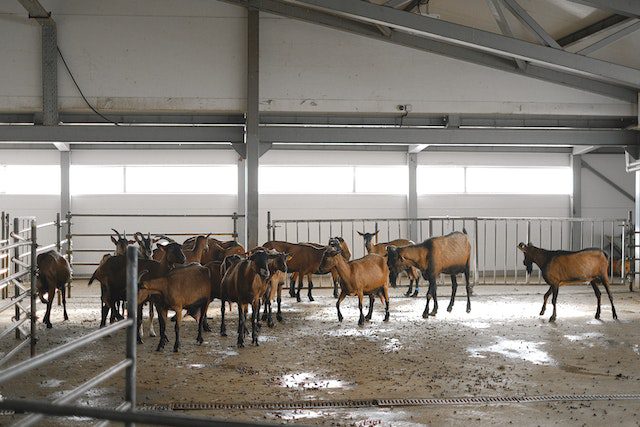
Most dairy goats are zero-grazed. Build a raised, slatted floor so droppings fall through.
The house must be rain-proof, well ventilated and free of draughts. Damp floors bring pneumonia and foot rot.
Deworm on a schedule, trim hooves and isolate any sick animal at once.
What One Doe Costs to Keep for a Year
About KSh 19,925 on our model, or roughly KSh 55 a day. At two litres a day, each litre costs about KSh 44 to produce.
One doe for one year (KSh, our model)
| Line | Amount | Basis |
|---|---|---|
| Fodder | 10,950 | 10 kg a day at KSh 3 a kilo, home-grown |
| Dairy meal | 5,475 | 300 g a day at KSh 50 a kilo |
| Minerals, dewormers and vet care | 2,500 | Our estimate |
| Breeding service | 1,000 | Our estimate |
| Cost per doe | 19,925 | Before labour and overheads |
Every line is an assumption. Bought fodder can double the feed cost in a dry season.
A five-doe unit also carries about KSh 60,000 a year in overheads on our model.
That covers part-time help, water, milk containers, transport and repairs.
The KSh 44 a litre figure is after selling surplus kids. Without kid sales it rises to about KSh 57.
Is Dairy Goat Farming Profitable in Kenya?
Yes, once you sell above about 0.7 litres a doe each day at KSh 120. Five does at two litres leave about KSh 213,875 a year.
Five does at three yields (KSh a year, our model)
| Litres a doe a day | Gross milk sales | Kid sales | All costs | Left for the year |
|---|---|---|---|---|
| 1.25 | 210,000 | 37,500 | 159,625 | 87,875 |
| 2 | 336,000 | 37,500 | 159,625 | 213,875 |
| 3 | 504,000 | 37,500 | 159,625 | 381,875 |
Kid sales assume 1.5 surplus kids a doe at KSh 5,000 each. Left for the year is before your own pay and tax.
At the Thika survey average of 1.25 litres, the unit leaves about KSh 7,323 a month.
At two litres it leaves about KSh 17,823 a month. Feeding, not breed, moves you between those rows.
Gross sales are not profit. The last column is what remains before you pay yourself.
The same five does at three prices (two litres a day)
| Price you receive | Where | Left for the year |
|---|---|---|
| KSh 100 | Farm gate, lower end | 157,875 |
| KSh 120 | Farm gate, our base case | 213,875 |
| KSh 180 | Direct delivery at KSh 200, less KSh 20 delivery cost | 381,875 |
Selling direct at KSh 200 earns as much as raising yield from two litres to three.
Scale changes the labour sum. Add one full-time worker at KSh 18,047 a month and five does only break even.
Twenty does at the same yield leave about KSh 758,936 a year after that worker.
But twenty does means 40 litres to sell every day. That is a marketing job, not a farming one.
Research agrees that margins are not automatic. A 2024 model of Kenyan flocks found one breed group with a negative gross margin (Springer).
Find the buyer before you buy the goat. Milk without a market is only a feed bill.
How Much Does It Cost to Start Dairy Goat Farming?
About KSh 85,000 for two does, or about KSh 210,000 for a five-doe unit. Stock and housing take two-thirds.
Milk for the home and a few neighbours.
- Two does and a small raised pen
- Buck service from a group
- Tests your feeding and your market
A side business run by the household.
- About 10 litres a day in milk
- Part-time help
- Break-even near 0.7 litres a doe
A full-time enterprise; our estimate.
- About 40 litres a day
- One worker and a cooler
- Dairy Board licence to process
Budget for a five-doe unit (KSh)
| Item | Budget | Basis |
|---|---|---|
| Five young does at KSh 20,000 each | 100,000 | Mid-range of 2026 asking prices. |
| Raised, slatted goat house for six to eight goats | 45,000 | Our estimate, using local timber and iron sheets. |
| First three months of feed, minerals and vet care | 20,000 | Before the first milk is sold. |
| Reserve for a sick animal or a late kidding | 15,000 | Our estimate. |
| Fodder plot: Napier, desmodium and fodder trees | 10,000 | Quarter of an acre, our estimate. |
| Transport of animals and a vet check on arrival | 9,000 | Depends on distance. |
| Troughs, milking buckets, strip cup and milk cans | 8,000 | Our estimate. |
| Share in a group breeding buck | 3,000 | A pedigree buck is shared by seven to ten farmers. |
| Total | 210,000 | Our example. Yours will differ. |
At two litres a doe, the unit earns back its cost in about a year of full milking.
Young does delay that by six to ten months. Budget for the wait.
If you plan to borrow, read how to get farm loans in Kenya first.
Yoghurt, Cheese and Breeding Stock: Where the Extra Money Is
Yoghurt and fermented milk, cheese, bottled pasteurised milk, breeding stock and manure. Processing fixes the two weak points: shelf life and seasonal gluts.
- 1Yoghurt and mala.A litre of milk makes about a litre of yoghurt, sold in small bottles.
- 2Cheese.Kenya has a national standard for goat cheese. Hotels and delis are the buyers.
- 3Bottled pasteurised milk.Longer shelf life and access to shops.
- 4Breeding stock.Registered doelings and bucks sell for more than milk earns in months.
- 5Manure.Bagged for vegetable growers and kitchen gardens.
Processing milk for sale needs a Kenya Dairy Board licence, including for a cottage industry (Dairy Industry Regulations).
Packaged products also need the standards mark. See milk processing in Kenya for equipment and costs.
A small cooler protects evening milk for morning delivery. Compare cheap milk coolers and chillers.
Where Can You Sell Goat Milk? Line Up Buyers First
Start within five kilometres: households, estates, clinics’ staff, shops and milk bars. Then approach one processor or group collection point.
- 1List twenty likely households.Parents of young children and older residents are the usual buyers.
- 2Take orders before you buy does.Ask for a weekly quantity and a price. Write both down.
- 3Deliver at a fixed hour.Clean, chilled, in sealed food-grade bottles.
- 4Join the nearest breeders’ group.Groups bulk milk, share bucks and negotiate with processors.
- 5Add one bulk buyer.A yoghurt maker or shop that takes the surplus on peak days.
Never mix goat and cow milk. Buyers test, and one bad delivery ends the account.
Keep kidding staggered so you can supply all year.
What Successful Dairy Goat Farmers in Kenya Do Differently
They feed for yield, keep records, stagger kidding and sell direct. None of it depends on a rare breed.
Do this
- 1Weigh milk daily for every doe
- 2Grow fodder before buying stock
- 3Sell direct where you can
- 4Cull low milkers early
Avoid this
- 1Buying on a seller’s litre claims
- 2Keeping an unrelated buck too long
- 3Relying on one buyer
- 4Health or cure claims on labels
Find the buyer before you buy the goat. Milk without a market is only a feed bill.
How to Start Dairy Goat Farming: Your First 90 Days
Secure orders, plant fodder and build the house. Then buy two to five registered does from a known breeder.
- 1Weeks 1 to 2: test the market.Collect written orders for at least five litres a day.
- 2Weeks 2 to 4: plant fodder.Napier, desmodium and fodder trees on a quarter acre.
- 3Weeks 4 to 8: build.A raised, slatted, ventilated house with a milking corner.
- 4Weeks 8 to 10: join a group.Register, and arrange buck service.
- 5Weeks 10 to 12: buy stock.Inspect records, tattoos and udders. Have a vet check each doe.
Want a free PDF manual? KALRO publishes guides on breeds and breeding and feeding dairy goats.
Then put your numbers on paper. Our farm business plan guide gives the layout.
For meat breeds and mixed herds, see goat farming in Kenya. For cows, see dairy farming in Kenya.
Planning a dairy goat or livestock enterprise?
Agcenture prepares farm business plans, market assessments and feasibility studies. Tell us your county and herd size.
Written by Agcenture
Agcenture helps Kenyan farmers and food businesses plan, finance and grow. Our guides use public sources and clearly labelled assumptions.
Questions readers ask
How much does a dairy goat cost in Kenya?
About KSh 15,000 to 25,000 for a good doe in 2026. Crossbreds start near KSh 8,000.
Which breed of goat is best for milk in Kenya?
Saanen yields most. Kenya Alpine and Toggenburg are hardier and easier to source.
How profitable is dairy goat farming in Kenya?
Our five-doe model leaves about KSh 213,875 a year at two litres a doe.
How many litres does a dairy goat produce per day?
Surveyed Kenyan farms average 1.3 to 2.5 litres. Top animals reach four or five.
Which county in Kenya is best for dairy goat farming?
Nyeri has the most dairy goats. Any cool area close to buyers works.
Does KALRO sell dairy goats?
KALRO centres sell pedigree bucks and some breeding stock. A 15-month buck was reported at KSh 15,000.
How much is goat milk per litre in Kenya?
About KSh 100 to 120 at the farm gate in 2026. Supermarkets charge up to KSh 300.