In this article
Key takeaways
- A Nation diarist's 500-egg incubator hatched about 80 per cent for five months. Then a blocked vent cooked a batch.
- Chick supply runs short at peaks. In 2024, waits for layer chicks reached nearly six months. Early orders still win.
- You need a Directorate of Veterinary Services licence to sell chicks. Chicks must carry the Marek's vaccine before sale.
- Incubation takes 21 days at about 37.5 degrees C. Sources differ on humidity, so calibrate your machine and follow its manual.
- A 128-egg start-up costs about KSh 47,000 on our estimate. It nets about KSh 4,350 a batch and pays back in about 11 batches.
- Power is over a fifth of the cost of setting an egg on our model. Solar kits cut that line and ride through power cuts.
- At 80 per cent hatch and KSh 110 a chick, break-even hatch is about 44 per cent. Egg quality, power and airflow decide it.
A chicken hatchery buys fertile eggs, incubates them for 21 days and sells vaccinated day-old chicks. You need fertile eggs from healthy breeders, an incubator with power backup, a veterinary licence to sell chicks, and buyers who book early. On our model, a 528-egg machine sells about 422 chicks a batch. It nets about KSh 10,750 a batch after labour, at 80 per cent hatch and KSh 110 a chick. Below a 44 per cent hatch you lose money.
Chicken Hatchery Business in Kenya: How One Blocked Vent Can Cook a Whole Batch
A Nation farm diarist paid KSh 64,000 for a 500-egg incubator. For five months it hatched about 80 per cent of the eggs. Then a batch of 180 eggs came out cooked. The first fault was a blocked exhaust vent (Nation).
That story holds the whole business. Eggs are cheap and chicks sell for more. Between them sit 21 days where heat, air and power must stay right.
This guide covers who buys chicks, where fertile eggs come from, and what the licence asks. You will see the 21-day schedule, the incubator prices, and the profit per batch for 128, 528 and 1,056 eggs. You will also see the hatch rate below which you lose money.
A hatchery does not sell eggs or chicks. It sells a hatch rate you can repeat.
Prices come from Kenyan sellers and press reports, with dates. The profit model is ours. We found no published accounts for a Kenyan micro-hatchery.
Who Buys Day-Old Chicks in Kenya? Waiting Lists Say Demand Is Real
In July 2024, the Association of Kenya Feed Manufacturers’ chairman said booking-to-delivery delays for layer chicks reached nearly six months. Hatcheries have since expanded. About three new companies started. The Kenya Poultry Breeders Association chairman says supply can now meet demand if farmers order early (The Star).
Improved indigenous chicks face the longest waits. Farmers and counties seeking KALRO’s KC1, KC2 or KC3 chicks can wait up to three months. Buyers reportedly pay about twice the normal price for these birds (ILRI).
The flock is mostly indigenous. KNBS counted 59.3 million indigenous chickens in 2024, about 75 per cent of all poultry (Zootecnica International). Each of those flocks needs fresh chicks.
Who buys from a small hatchery
| Buyer | What they want | Evidence |
|---|---|---|
| Kienyeji farmers | Improved kienyeji chicks, vaccinated | Chicks sell at KSh 90 to 150 (Fama, September 2026) |
| Layer farmers | Layer chicks, booked early | KSh 140 to 170 in July 2024 (The Star) |
| Broiler farmers | Uniform broiler chicks | Most day-old broilers come from commercial stock (ILRI) |
| Brooders and nurseries | Day-old chicks to grow to 2 to 4 weeks | See our brooding guide |
| Egg owners | Hatching of their own eggs | One Murang’a hatchery charges KSh 20 an egg (KNA) |
Small hatcheries do best with improved kienyeji and layer chicks, not broilers.
Most commercial chicks reach farmers through veterinary drug stores, 96 per cent in an ILRI study. The same study saw long travel times and transport stress (ILRI). A hatchery that delivers close to its buyers has an edge.
What day-old chicks sell for
Day-old chick prices, 2025 and 2026
| Chick | Price a chick (KSh) | Note |
|---|---|---|
| Broiler | 95 to 105 | Kenchic, Irvines and Suguna at 105. Isinya and Silverlands at 95. |
| Kenbro | 115 | Kenchic |
| Kuroiler | 110 | Beyond Forest listing |
| Sasso | 130 | Silverlands and Interchick |
| Navogen kienyeji | 120 | Confirm with supplier |
| Layer | 130 to 160 | The source gives both ranges |
Source: Beyond Forest, October 2025. Prices are indicative. Kenchic usually asks for advance booking and a deposit.
A documented hatchery chick costs about KSh 30 to 150 more than an informal one, says Fama. Buyers pay for papers and vaccination. Illegal hatcheries cause weak chicks and high mortality, farmers told Food Business Africa in 2023. The Directorate of Veterinary Services promised to act (Food Business Africa).
Where Do You Get Fertile Eggs? The Golden Rule of Hatching
Your hatchery is only as good as its eggs. Eggs from commercial layer farms are normally unfertilised. They will not hatch. You need eggs from hens that run with cocks.
Running your own breeder flock is more convenient than buying eggs, says a Nation report on hatchery rules. It also gives you control of the breed and the health record. Buying eggs lets you start with less capital.
Hatching egg rules
| Item | Guide | Source |
|---|---|---|
| Cocks to hens | 1 cock for 10 hens | KALRO |
| Hen age | 25 weeks or older | KALRO |
| Egg weight | 45 to 60 g, medium and uniform | KALRO |
| Collection | Every two hours. Never use floor eggs. | KALRO |
| Age when set | Within 4 days is best. Past 7 days, hatch falls. | Kenchic vet |
| Storage | 20 C to day 4. 16 C to day 8. 14 C to day 10. | KALRO |
| Position | Pointed end down | KALRO |
| Rest after transport | 24 hours, so the yolks settle | The Standard |
| Cleaning | Wipe soiled eggs dry. Do not wash. | The Standard |
Sources conflict on egg position: the Kenchic vet says broad end up, KALRO says pointed end down. We follow KALRO. Ask your machine maker.
Breeders should be tested for Pullorum disease at 18 to 22 weeks. They should also carry Newcastle, Marek’s, Gumboro and other vaccines (Nation). Ask each egg supplier for these records.
We found no published price for a fertile egg in Kenya. Our model uses KSh 30 an egg. Test it against your suppliers and see the sensitivity table below.
Put your egg supply in writing
Flock and breed
Name the breed, the cock-to-hen ratio and the flock health record.
Egg age and size
Set a maximum egg age, a weight range and a rule for cracked eggs.
Price and pickup
Agree a price a tray, a pickup day and a credit for eggs that arrive dirty.
This checklist is our advice. Track hatch rate for each supplier. After three batches you will know who to keep.
Licence First: What the Law Asks of a Hatchery
A Directorate of Veterinary Services licence is required to run a hatchery that sells chicks. The Directorate inspects the site against its 2018 hatchery and breeding farm protocol. Running without a licence breaks the Animal Diseases Act. The penalty is up to six months in prison, a fine of up to KSh 5,000, or both (Nation).
The same report asks for an environmental impact assessment under NEMA. Veterinary inspectors then inspect each year. Day-old chicks must carry the Marek’s vaccine before sale.
Hatchery licence steps
| Step | What you do | Cost and time |
|---|---|---|
| Site approval | Ask the sub-county vet office to inspect the plot | Fee not stated on the source page |
| Plans and permits | Get plans approved, plus a construction permit and public health approval | Set by your county |
| Environmental licence | Submit an EIA report to NEMA | Report about KSh 50,000 |
| Hatchery licence | Apply to the county vet office, then pass the follow-up inspection | KSh 1,000 to apply, KSh 5,000 for the licence |
Source: Wikiprocedure, which volunteers edit. It puts the whole process at 58 to 92 days. Confirm every fee with the Directorate.
The site rules shape your build. Keep the hatchery 50 to 100 m from other livestock. Use surfaces that are easy to clean and disinfect. Add a fence and foot and wheel baths. Separate the areas for egg receipt, incubation, hatching, sorting, vaccination and dispatch.
A small operation may share one room if tasks are separated in time and the room is disinfected between them. Our advice is to ask your county vet whether a 128-egg unit needs the full licence. We could not read the 1985 Hatcheries Rules text, so we cannot say.
The 21-Day Incubation Schedule: Temperature, Humidity and Turning
Incubation is a 21-day routine. Sources agree on the days and on about 37.5 degrees C. They differ on humidity, so read them side by side.
Incubation settings, five sources
| Source | Temperature | Humidity | Turning |
|---|---|---|---|
| Kenchic vet | 37.5 C | 63 to 67% | Hourly, 45 degrees, first 7 days |
| Nebraska guide | About 37.2 C, forced air | 50 to 55%, then 60 to 65% | Turn to day 17. Stop day 18. |
| Nation diarist | 37.8 C, then 37.5 C | 60%, then 70% | Not stated |
| Fama, 2026 | 37.5 to 37.8 C | 45 to 55%, then 65 to 75% | Not stated |
| IITA guide | 38 C | 60 to 80% | 3 times a day to day 18 |
Sources: Kenchic vet, University of Nebraska, Nation, Fama and IITA. Nebraska gives 99 F for forced air, which we converted. Follow your machine maker’s manual.
Machines differ, so no single table fits every unit. Calibrate your thermometer and hygrometer before the first batch.
Test run
Run the empty machine for 24 hours. Check heat, humidity and fan against a second thermometer.
Set the eggs
Rest eggs 24 hours, then set them with the pointed end down. Mark the date and supplier.
Days 1 to 17
Keep heat steady and turn the eggs. Check the water pan. Never block a vent.
Candle on day 7
Remove clear eggs and any that smell. Nebraska says fertility can show from day 3.
Day 18 lockdown
Stop turning. Open the vents fully and raise humidity per your manual. Do not open the lid.
Days 19 to 21
Chicks pip from day 19. All viable chicks should hatch by day 21. Late chicks are often weak.
Day 7 candling is our suggestion. Lift clear eggs at once. A bad egg can spoil the rest.
Check chick weight at hatch. A good chick weighs about two-thirds of its egg, says Kenchic’s vet. A 50 g egg should give a chick near 33 g (The Standard).
Good management hatches 80 to 90 per cent of the eggs set, says Fama. A guide from IITA gives 85 to 90 per cent of fertilised eggs (IITA). The Nation diarist’s rate fell to between 10 and 28 per cent after the faults began.
Incubators, Power Backup and Room: What to Buy and What It Costs
Pick the machine for your buyers, not for its egg count. A big machine needs a big weekly sale. Start small and prove your hatch rate.
Incubator prices at one Kenyan seller
| Eggs | Price (KSh) | Note |
|---|---|---|
| 64 | 13,500 | |
| 128 | 18,000 | Small start-up size |
| 204 | 25,500 | Solar, automatic |
| 256 | 26,000 | AC/DC solar |
| 320 | 32,000 | Solar |
| 528 | 55,000 | Our model uses this price |
| 1,056 | 60,000 | Our model allows 90,000, as other sellers charge more |
| 2,112 | 120,000 |
Source: Ecochicks price table. The page has no date.
Other prices run higher. A price guide puts automatic 96 to 128 egg units at KSh 25,000 to 45,000. It puts 500 to 1,000 egg units at KSh 85,000 to 180,000 (Achi Systems, January 2026). A Murang’a hatchery paid KSh 40,000 for 264 eggs and KSh 90,000 for 1,064 eggs (KNA). The Nation diarist paid KSh 64,000 for 500 eggs.
Our model uses KSh 25,000, 55,000 and 90,000 for 128, 528 and 1,056 eggs. Ask for a warranty, spare parts and a demonstration hatch.
Power backup is not optional
One Kenyan hatchery owner says a standby generator is essential. He spends KSh 16,000 to 20,000 a month on power (The Standard). A power cut or heat spike can ruin a whole batch.
Backup power is not enough alone. The Nation diarist’s first fault was a blocked vent, not an outage. So build the backup, and also check airflow every day.
Everything else you need
Add a candling torch, a second thermometer and hygrometer, egg trays, disinfectant, chick boxes and a vaccination kit. Keep the room cool, steady and clean. Wash the machine between batches.
Can a Solar Incubator Cut Your Hatching Costs? Power Is Over a Fifth of Every Egg
Power is KSh 12 of the KSh 54 it costs to set one egg on our model. That is over a fifth of your production cost. One Kenyan hatchery owner spends KSh 16,000 to 20,000 a month on electricity (The Standard). Solar targets that line.
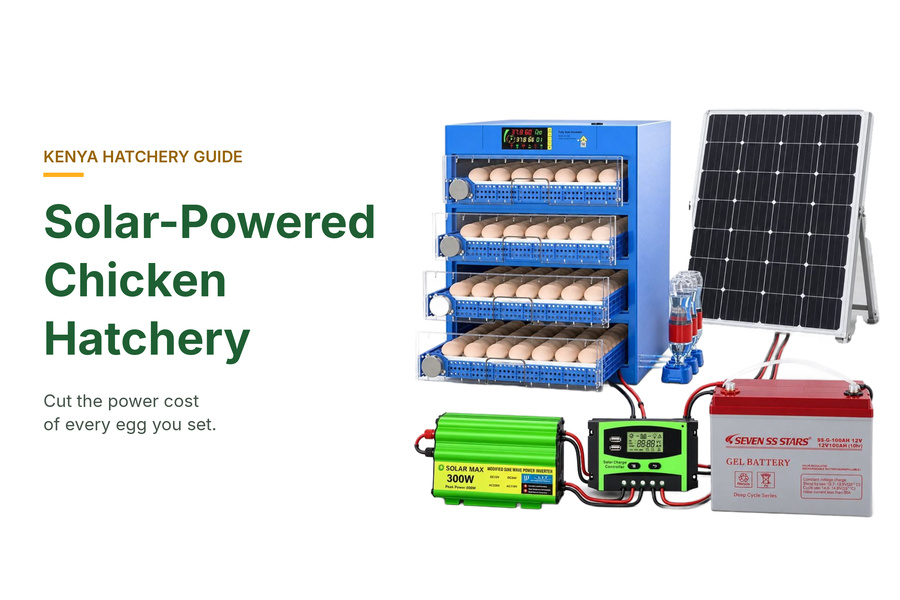
A solar-ready machine runs from a 12 V battery that a panel keeps charged. Your grid or generator bill shrinks. The machine can also ride through a cut.
Solar will not raise your hatch rate. It takes cost out of every egg you set.
Solar and solar-ready incubators on sale in Kenya
| Eggs | Price (KSh) | What the listing says |
|---|---|---|
| 64 | 15,000 | Eco Solar, automatic turning (Ecochicks) |
| 112 | 20,000 | Digital, solar powered (Ecochicks) |
| 128 | 46,600 | Complete kit: 200 W panel, 120 Ah battery, 20 A controller (Madukani) |
| 128 | 25,000 | AC/DC machine. Runs on 240 V grid or 12 V solar (EcoKuku Farm) |
| 300 | 54,000 | Huru300, solar, fully automatic (Ecochicks) |
The 128-egg kit price includes the panel and battery. The EcoKuku price is for the machine only. Prices have no dates.
The Madukani listing says its battery can run the incubator for 40 hours. That is the seller’s claim. Ask for a demonstration before you pay.
Sellers claim hatch rates of over 90 per cent, but give no figures by model (Ecochicks). Two Mombasa engineers built a 90-egg unit and report 80 per cent hatch from their own tests. It uses a 120 W panel and a 100 Ah battery. It sold for KSh 35,000, or KSh 45,000 with solar (Nation, undated). Treat all these as seller or maker claims.
What solar saves on our model
Power cost and what solar could save
| Machine | Power a batch | Saved a year, half | Saved a year, all |
|---|---|---|---|
| 128 eggs | KSh 1,536 | KSh 11,520 | KSh 23,040 |
| 528 eggs | KSh 6,336 | KSh 47,520 | KSh 95,040 |
| 1,056 eggs | KSh 12,672 | KSh 95,040 | KSh 190,080 |
Power is our KSh 12 an egg allowance over 15 batches. Half and all show how much of it solar covers. Cloudy weeks mean you will not reach all.
At 128 eggs, the solar kit costs KSh 9,600 more than a grid machine with a backup battery. The kit replaces that backup. If solar covers all your power, you recover the difference in about 6 batches. If it covers half, it takes about 12.
Savings grow with machine size, because power rises with every egg. At 528 eggs the power line is KSh 95,040 a year. We found no priced complete solar kit above 300 eggs. Ecochicks lists a 528-egg machine that runs on solar through an inverter, but shows no price (Ecochicks).
Solar also protects the batch. A Kitui farmer who sells chicks told IIED that a five-day cut spoiled her 192-egg batch. She lost KSh 19,200 in sales and about KSh 5,500 in running costs. Two-thirds of grid-connected farms in the survey had supply problems (IIED, April 2022).
Know what a cut does. Brinsea, an incubator maker, says cooling for 30 to 40 minutes a day after the first week does no harm. For longer cuts in the first 14 days it advises chilling the eggs to pause development, and it warns of losses. After day 14, keep the lid shut and warm the room (Brinsea). It gives no hatch-rate figures for outages, so we do not quote one.
Before you buy a solar unit
Ask for the load
Get the machine’s watts and the battery hours in writing. Size the panel to match.
Test a cut
During the empty trial run, switch off the grid. Check that heat and turning continue.
Plan for cloud
Keep a grid or generator link for rainy weeks. A hybrid set-up is safest.
Mind the size
Solar units usually hold fewer eggs, says IIED. Check the tray count before you pay.
Prefer 12 V DC
An inverter wastes power. Good sine-wave units run at 90 to 95 per cent, cheap ones at 75 to 85, says Penn State.
Insulate the room
Our advice: a steady, cool room means the heater works less and the battery lasts longer.
Inverter efficiency figures come from Penn State course notes. Efficiency also falls at low loads, so size the inverter to the machine.
Researchers at MIT D-Lab are testing a different idea. Their Cameroon prototype holds up to 90 eggs and uses solar-heated bulbs with beeswax thermal batteries. It reports no hatch rates yet, so treat it as an idea to watch (MIT D-Lab).
Plan your hatchery with real numbers
Send us your breed, county and buyers. We will price the machine, power backup, licence steps and your break-even hatch rate.
Ask on WhatsAppDay One: Marek's Vaccine, Chick Boxes and Delivery
Hatcheries vaccinate against Marek’s disease in the first hours, says Fama. Many add Newcastle and infectious bronchitis at the hatchery too. The farm’s own programme starts around day seven. Ask your vet which vaccines your buyers need.
Vaccination costs USD 0.05 to 0.10 a chick, says IITA. Our model uses KSh 10. Leave the chicks in the machine until they are dry and fluffy. Then sort out weak ones and box the rest.
Match delivery to hatch day. Good hatcheries take orders weeks ahead, says Fama. Long trips may need an overnight hold with warmth and water. Take deposits before you set eggs. Buyers already expect this: the Nation diarist paid KSh 10,000 up front for 200 chicks.
Chicks that stay on your farm need heat at once. See our brooding guide and our guide on why chicks die.
Does a Hatchery Pay? Profit per Batch for 128, 528 and 1,056 Eggs
A machine that sets and hatches in one unit runs a batch every 21 days. We plan 15 batches a year, to allow for clean-outs and slow weeks. The model sells improved kienyeji chicks.
Assumptions behind the model
| Line | Value | Basis |
|---|---|---|
| Hatch rate | 80 per cent of eggs set | Range 80 to 90 (Fama) |
| Chick price | KSh 110 | Kuroiler KSh 110 (Beyond Forest) |
| Fertile egg | KSh 30 | Our assumption. No published price. |
| Power and disinfectant | KSh 12 an egg set | From KSh 1,500 for 128 eggs |
| Vaccine and box | KSh 15 a chick | Vaccine KSh 10, box KSh 5 |
| Batches a year | 15 | Our assumption |
| Labour | KSh 0, 9,000, 18,000 a month | Owner, 1 and 2 workers |
Worker wages follow the KSh 9,000 farm rate from our layers model (WageIndicator).
One batch: income and costs
| Machine | Chicks sold | Income | Costs |
|---|---|---|---|
| 128 eggs | 102 | KSh 11,264 | KSh 6,912 |
| 528 eggs | 422 | KSh 46,464 | KSh 28,512 |
| 1,056 eggs | 845 | KSh 92,928 | KSh 57,024 |
Costs are eggs, power, vaccine and boxes. Labour comes next.
Net profit after labour
| Machine | Net a batch | Net a year | Start-up cost |
|---|---|---|---|
| 128 eggs | KSh 4,350 | KSh 65,000 | KSh 47,000 |
| 528 eggs | KSh 10,750 | KSh 161,000 | KSh 115,000 |
| 1,056 eggs | KSh 21,500 | KSh 323,000 | KSh 210,000 |
Start-up covers the machine, power backup and room kit. A licence and EIA add about KSh 56,000, from the Wikiprocedure fees.
Each egg set earns about KSh 34 before labour. That is about KSh 42 a chick sold. The 128-egg unit pays back its KSh 47,000 in about 11 batches. That is about 7 months of back-to-back hatching.
Power is KSh 12 of the KSh 54 it costs to set an egg. See the solar section above for how to cut it.
Add the licence and EIA, and that payback stretches to about 24 batches. So a 128-egg unit suits a farm that also uses its own chicks. Larger machines spread the licence cost.
Hatch rate is the profit line. Below 44 per cent, every batch loses money.
Net per batch, 528-egg machine, by hatch rate
| Hatch rate | Net a batch |
|---|---|
| 30 per cent | minus KSh 14,328 |
| 50 per cent | minus KSh 4,296 |
| 70 per cent | KSh 5,736 |
| 80 per cent | KSh 10,752 |
| 90 per cent | KSh 15,768 |
Break-even hatch is about 44 per cent. At 90 per cent you net about KSh 15,750.
Net per batch, 528-egg machine, by price
| Chick price | Net a batch | Egg cost | Net a batch |
|---|---|---|---|
| KSh 90 | KSh 2,300 | KSh 25 | KSh 13,400 |
| KSh 110 | KSh 10,750 | KSh 30 | KSh 10,750 |
| KSh 130 | KSh 19,200 | KSh 40 | KSh 5,450 |
Left pair: chick price, with eggs at KSh 30. Right pair: egg cost, with chicks at KSh 110.
If you hatch other farmers' eggs instead
Custom hatching charges a fee and carries no price risk. One Murang’a hatchery charges KSh 20 an egg (KNA). The Nation diarist also priced outsourced incubation at KSh 20. After KSh 12 an egg for power, that leaves about KSh 8 an egg. A 528-egg batch earns about KSh 4,200.
That is far less than hatching your own eggs. Yet it needs no egg stock and no chick buyers. You could start with custom work, then add own-account batches.
Show the full budget for one 528-egg batch
One batch, 528 eggs
| Line | KSh |
|---|---|
| Income | |
| Chicks sold: 422 at KSh 110 | 46,464 |
| Direct costs | |
| Fertile eggs: 528 at KSh 30 | 15,840 |
| Power and disinfectant: KSh 12 an egg | 6,336 |
| Vaccine: KSh 10 a chick | 4,224 |
| Chick boxes: KSh 5 a chick | 2,112 |
| After labour | |
| Labour share, one worker | 7,200 |
| Net a batch | 10,752 |
Five Shifts That Will Change Your Hatchery
Shifts to plan for
| Shift | What is happening | What to do |
|---|---|---|
| Illegal hatcheries | Farmers want a crackdown, and the Directorate promised one in 2023 (Food Business Africa). | Get your licence early. Show it to buyers. |
| Improved indigenous supply | KALRO plans licensed private hatcheries and a franchise model for its KC chicks (ILRI, August 2026). | Watch the franchise terms. Ask KALRO about parent stock. |
| Bird flu and egg imports | Kenya imported about 412 tonnes of hatching eggs (Zootecnica). Farmers warn against chicks from bird flu countries (Capital FM). | Source eggs locally. Keep supplier records. |
| Power cost and solar | One hatchery spends KSh 16,000 to 20,000 a month on power (The Standard). A Kitui farmer lost a batch to a five-day cut (IIED). | Price a solar-ready machine against grid power. |
| Chick quality and transport | ILRI saw long trips and transport stress for chicks (ILRI). | Deliver close to buyers. Use boxes with airflow. |
These are trends, not forecasts.
Start in 8 Steps
- 1Pick your chick. Choose improved kienyeji or layers, and name ten buyers.
- 2Take deposits. Ask for a deposit before you set any eggs.
- 3Ask the county vet. Confirm the licence your hatchery size needs.
- 4Lock in eggs. Sign with one or two breeder farms, or start your own flock.
- 5Buy the machine. Add a battery or generator before the first batch.
- 6Run a test. Run it empty for 24 hours and calibrate the readings.
- 7Hatch a small batch. Vaccinate, box and deliver the same day.
- 8Record your hatch rate. Track it by supplier, then scale up.
Questions Readers Ask About the Chicken Hatchery Business
Is a chicken hatchery profitable in Kenya?
It can be. Our model nets about KSh 4,350 a batch from 128 eggs and about KSh 10,750 from 528 eggs, after labour. It assumes 80 per cent hatch and chicks at KSh 110. Hatch rate decides profit.
How much does it cost to start a hatchery in Kenya?
A 128-egg start-up costs about KSh 47,000 on our estimate. That is the machine, power backup and room kit. A licence and EIA add about KSh 56,000.
How long do chicken eggs take to hatch?
Chicken eggs hatch in 21 days. Chicks may pip from day 19. Chicks that hatch after day 22 are often weak, says a University of Nebraska guide.
What temperature should an incubator run at?
Kenchic's head vet gives 37.5 degrees C. Other Kenyan sources range from 37.5 to 38. Calibrate your thermometer and follow your machine maker's manual.
What humidity do chicken eggs need?
Sources differ. The Kenchic vet gives 63 to 67 per cent. Nebraska gives 50 to 55 per cent, then 60 to 65. Fama gives 45 to 55, then 65 to 75. Follow your manual.
How often should I turn the eggs?
Turn through day 17 and stop on day 18, says Nebraska. Machines with automatic turners do it hourly. The Kenchic vet advises hourly turning at 45 degrees for at least 7 days.
When should I candle the eggs?
We suggest day 7, then again near day 14. Remove clear eggs at once. Nebraska says fertility can show from day 3.
How long can I store eggs before setting?
Set eggs within 4 days if you can. After 7 days, hatch rates fall. Store them pointed end down in a cool room.
Can I hatch eggs from a market or a layer farm?
Usually not. Commercial layer eggs are normally unfertilised. Buy fertile eggs from breeders that keep cocks with the hens, at about 1 cock for 10 hens.
Do I need a licence to sell day-old chicks?
Yes. A Directorate of Veterinary Services licence is required for a hatchery that sells chicks. Ask your county vet whether a very small unit is treated differently.
Do chicks need the Marek's vaccine before sale?
Yes. A Nation report on the licence says day-old chicks must carry the Marek's vaccine before sale. Many hatcheries add Newcastle and bronchitis vaccines.
What hatch rate should I expect?
Good management hatches 80 to 90 per cent of eggs set. A Nation diarist hatched about 80 per cent until a blocked vent and faults cut it to between 10 and 28.
Which incubator should I buy?
Start with 128 to 528 eggs and an AC/DC or solar machine. One Kenyan seller lists 128 eggs at KSh 18,000 and 528 eggs at KSh 55,000. Ask for a warranty and spares.
Does a solar incubator lower my cost of production?
It cuts the power line, about KSh 12 of the KSh 54 it costs to set one egg on our model. At 128 eggs, a solar kit recovers its extra cost in about 6 batches if it covers all power. It also rides through outages.
How much does a solar egg incubator cost?
Listings run from KSh 15,000 for 64 eggs to KSh 54,000 for 300 eggs. A complete 128-egg kit with panel and battery is KSh 46,600 at one seller. Prices are undated, so confirm them.
How do I protect a batch from power cuts?
Use an AC/DC machine with a battery, or keep a standby generator. Check vents and airflow every day too. A blocked vent ruined one diarist's batch.
How much can I charge for custom hatching?
One Murang'a hatchery charges KSh 20 an egg. After power costs, that leaves about KSh 8 an egg on our model.
How many chicks will 128 eggs give?
At 80 per cent hatch, about 102 chicks. At 90 per cent, about 115. A chick should weigh about two-thirds of its egg weight.
Ready to plan your hatchery?
Tell us your county, machine size and buyers. A farm adviser replies within one working day.
Written by Agcenture
We help farmers and agribusinesses across Kenya plan farms, grow profitably and reach markets. Our guides use public sources and field experience.