Do you want to know how much money you will make from your farming business? In this post, we give you a simple farm profits calculator using the cost-benefit analysis formula or method. You can do it in budgeting for the entire farming project or a specific crop or livestock.
The cost-best analysis (CBA) method is the easiest farm profits calculator method. The budget formula can help you to assess the economic feasibility of your project before investments. It will help to value total costs, earnings, and profits for any type of crop or livestock in advance.
The additional analysis methods for detailed analysis are the gross margin analysis (GMA), Net Present Value (NPV), Return on investment (ROI), Break-even analysis, and the payback period among others.
How to use the Cost- Benefit Analysis
A CBA is a necessary evaluation if you are starting or expanding your farming project. You can use it to assess, rank, and choose what to raise before investment. You can also identify and estimate the costs to incur and benefits to accrue beforehand. The other benefits of CBA as a planning and decision-making tool are;
- Determine feasibility or profitability of a crop or livestock production before investment.
- Compare and rank various crops and livestock that are viable in your agroecological zone (AEZ).
- Settle the best crop or livestock that is most beneficial to your farm.
- Use it to set and negotiate selling prices for your farm commodities.
- Make a buy or lease investment decision by comparing profits under various conditions
Steps for Making a Farm Budget
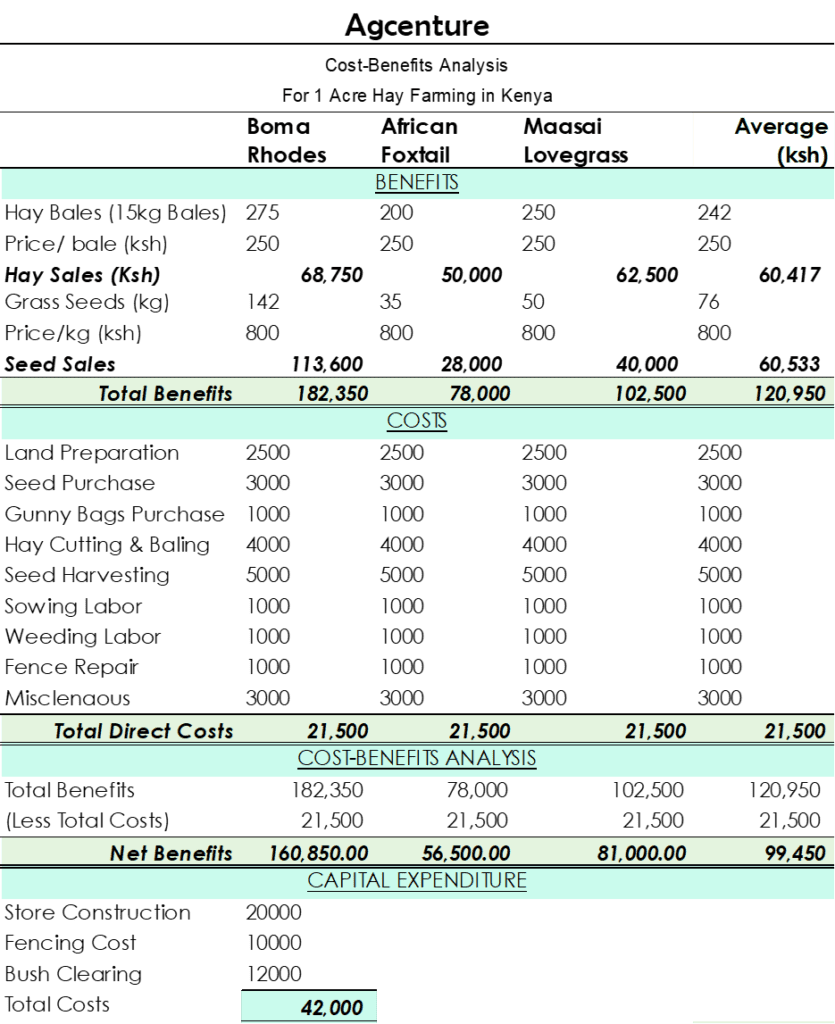
It is easy to carry out a CBA for your farm. Subtract the total costs from your target earnings. Whether you look into running a commercial ranch, a chicken farm or a vegetable greenhouse, this guide is yours. Follow the following three steps;
- Identify all the relevant costs and benefits associated with crop or animal farming from land preparation to marketing including both the direct and indirect costs.
- Value or assign cash or monetary value to each cost or benefit
- Compare total costs and benefits (earnings) to determine if the benefits outweigh the costs.
- Compare different options to make an informed investment decision.
We explain these steps in more details.
Identifying Costs
Your farm will incur many costs that are fixed or flexible. Others may be indirect or tangible. For simplicity we have categorized the typical farm expenses into and into following types;
Land preparation costs
This is the initial cost to put your farm in a production state. you will need to acquire land, prepare it and set up infrastructure.
- Land acquisition; The cost to buy or lease your farm land. You may need fees to rezone or convert it from a commercial or industrial farm to an agricultural land. Finally, you will spend some money for site planning.
- Land preparation These are costs to convert your virgin or abandoned land to a productive farm. you will need to put up fencing, signage and testing for soil and water quality. Other costs are tilling, making drainage and laying down of irrigation kits.
- Infrastructure A smart farm will require you to put up the latest farm assets for efficient production and preservation of fresh produce. You may have to use money to buy irrigation water pumps erect greenhouses, growing tunnels, cold rooms and cooler shades. Its more profitable to lease, or cost-share these with neighbors.
Labor costs
These are the total salaries, wages and benefits you will pay from land preparation to harvesting of your commodity. You will have to figure the total man-days or hours you need to till, plant, spray, harvest and market produce. Find the labour cost by getting the product of the worker needs and the price of one man per day.
Farm Management costs
You can group the expenses you need to grow and sell a product into three;
- Tools; Cost of buying or hiring tools and machinery like tractors and water pumps. Poultry and dairy farmers will need feeders, water troughs and cages.
- Growing supplies; These are costs to get Seeds, seedlings, fertilizer and pesticides to grow your crops. As a herder, you will pay for vaccines, animal feeds and fodder. Other supplies are packaging bags to weigh, store and transport your products to the market.
- Utility costs; During your growing and marketing phase, you will incur costs for water and electricity. The other utility bill on your farm is insurance cost for crops, animals and assets.
Marketing Costs
These are internet printing and calls expenses for communicating with your buyers. If you have a farm website, spend its costs of hosting, upkeep and design.
Management costs
Outsource some farm operations to an outsider. It will give you more time to concentrate on efficient farming. In your CBA, identify and value for the costs to pay to consultants like marketers, lawyers and vets. Others are agronomists and auditors.
Miscellaneous costs
Each project has unexpected expenses. Once you have the total cost for running your farm for a year, determine a certain percentage (e.g. 10%) of the total as a cushion from any expected risk.
How to calculate Sales Revenues
To get the total returns from your farm; multiply the expected or actual farm yields by the average selling price per unit like a kilogram, liter, or tray. For instance, if the average selling price for a 90-kilogram bag of maize is Ksh. 2500. Your earnings from 20 of them would be Ksh. 50,000. The actual yields will give you actual revenues while the expected yields will help you determine the expected benefits.
How to assign Costs and Prices
Accessing the right data is crucial for accurate estimates. The information on prices and costs is inaccessible to most farmers. You can gather it from supplier catalogs, and the farms’ records, or use your experience to determine it. Besides, enquire from the markets and published information on websites.
How to estimate your farm gross and net profits
To determine your farm profits; get the difference in total costs from your earnings using the following formula.
Net Benefit (losses) = Total Benefits – Total Costs
If your balance is positive, your farm will make a net profit. If it’s negative, you will make a loss by growing the intended crop or animal.
You should not invest in a crop or animal that will make a loss.
For accurate estimates, do a sensitivity analysis. You will have CBA for 3 case scenarios: best, typical, and worst. You assume the highest yields (e.g. 110%) and earnings in the best case and vice versa.
Other farm profits analysis methods
The CBA method in this guide is un-discounted. Though it is straightforward, it should not be the only decision criterion. Other investment and budget analysis methods for your farm include;
- Break-even analysis; A profit analysis for the number of products you must sell to at least cover your costs.
- Payback period; the number of years (or seasons) your farm will take to recover costs. A crop or livestock with a shorter period is more desirable.
- Return on investment (ROI); It is the ratio or percentage of your benefits or returns from an investment.
- Net present value (NPV); the real cash value of all your future cash flows discounted for time value for money and inflation. You should avoid a project with a negative NPV.
Agcenture provides services budgeting, cash flow projections, and financial and investment analysis. We offer this for small, medium, and large-scale firms like flower farms, ranches, or milk processors. Use our services for informed investment decisions. Get a quote today.
Read Next The following are five examples of calculating farm profits using the cost-benefit formula.
Read Next
How Profitable is maize farming in Kenya?
How profitable is broiler farming in Kenya?
How profitable is Spinach farming in Kenya?