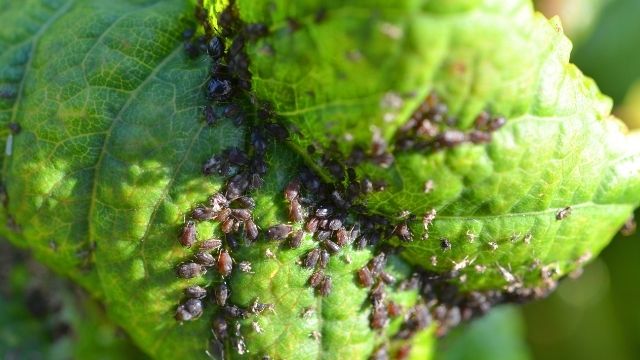
Are you wondering how to control aphids on your flowers like roses and vegetables like tomatoes? This aphid management guide has some of the most cheap and effective natural solutions that you can consider. It has tips for early monitoring and identifying small populations before destruction.
In case they are already destructive large colonies, we give you various safe aphid control methods like; companion planting and a list of natural/safe products and solutions fit for organic farmers who prefer integrated pest management (IPM) to use of chemical pesticides
What are Aphids?
You can find the plant lice on different parts of the plants like the leaves, stems, flower buds or fruits. They can be yellow, grey or red while others are brown, black or fluffy white. Some female species have wings and can fly. To date, there are over 5000 species of identified aphids’ species.
The little sap-sucking bugs range from 1/16th to 1/4th of an inch. Though they are small, they reproduce fast. A single female aphid can reproduce up to 600 billion descendants. Interestingly, they are parthenogenetic and reproduce both sexually and asexually.
The aphids stunt your vegetables and flowers growth leading to huge financial losses. Spraying them with chemical pesticides may expose you to harmful intoxication, hence the reason for safer organic solutions in this post.
How to Monitor & identify aphids on your vegetables or flowers garden
Which crops do aphids destroy? Aphids attack a range of food and cash crops. They can infest both indoor (greenhouse) and open field managed crops like cabbages, tomatoes, tomatoes, peach and melons. You can also find them on flower farms attacking roses and petunias. On kitchen farms, they mostly destroy kales, corn and spinach.
To identify them, look on the underside of leaves. The leaves may appear upset, curled, stunted and yellow. If you find a large population of ants or ladybugs on the plants, it may be an indicator of greenflies. They produce a waste substance; the honeydew, a sticky and sugary substance. Your plant may become black as honeydew can cause sooty mould from fungal growth. They can distort or deform flowers and fruits from overfeeding.
How to Prevent aphids in your farm
An attack shows your plants are suffering drought, heat stress, excess fertilizers or water. Try good gardening practices to keep aphid populations low. It will keep the plant lice away from your garden. These measures include;
Precise irrigation
Inadequate or excess water availability for your plants is unfit for your plants. Drought-stricken crops have their plant sap concentrated with rich sugars and minerals. Aphids can get a meal in a short time, killing your plant fast. A heat struck plant cannot reproduce natural pesticides to fend off plants. The over-watered plants are succulent and attractive to different insects.
To avoid the above, ensure the correct watering of plants. Use moisture testing kits to measure the amount of water available for plants on the soil. It will inform you in precise irrigation to water your crops with enough water needs.
Precise fertilizer Application
Excess plant nutrients will make your crops bloom. The tender green shoot attracts aphids. You can avoid this by testing for your soil qualities. Use the results for precise fertilizer application to provide crops with nutrients. Besides, you can use organic fertilizer with slow-release properties or have multiple applications throughout the growing period.
Companion planting
It is an organic farming technique for pest and weed control. It involves growing either repellent or trap crops.
- Trap crops; A trap crop is a decoy plant you will plant on the perimeter of the vegetable garden. The sacrificial crop will attract and hold the destructive aphids from the valuable crops. If the pest swarms overwhelm them, uproot or move the containers away to make sure they do not jump to the plant. The best trap crops are stinging nettle, nasturtiums, mustard and calendula.
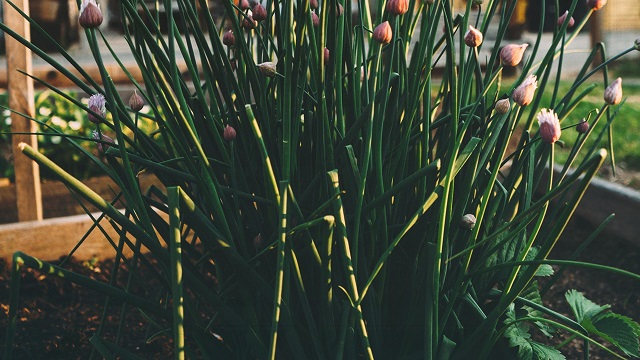
- Repellent crop; These plants have a potent scent that repels aphids from valuable crops. Plant them around in and around the perimeter. Alternatively, plant them in containers that you can place and remove from the farm. The powerful aroma will deter aphids from coming into the shamba. Some crops with strong fragments are marigold, catnip, dill, chives and peppermint.
Monitoring and Evaluation
Have a habit of inspecting your crops often. It will help you diagnose and identify an early aphid’s infestation as explained in the section above. Monitor both the trap and the main crops. If it infests them, you can manually control the infestation by uprooting the crops. Or you can control them as follows;
How to control aphids organically
Use the natural control methods and organic aphid spray products when the insect colonies have invested crops. They include;
Clean water
Like rainwater washes and floods away pests, spray your crops with cold and clean water to control aphids. As you hose the leaves or stems, the cold water will dislodge the fragile bugs to the ground. The small pests cannot find their way back to the crop.
Flour
Where water spraying does not work dust your plants with flour. It will constipate them and control the invasion.
Natural predators
One of the most eco-friendly methods of pest control is using natural predator against them. Aphids are prey to various birds and insects. You can introduce or encourage them to live in and around your crops by;
- Birds; build bird feeders and houses near your crops. The friendly birds like sparrows and herons will visit and eat the bugs controlling their populations.
- Insects; Similarly, ladybirds, lacewings, parasitic wasps and aphid midge are proficient hunters of aphids. You can introduce them by ordering some online. However, monitor your crops for destructive insects too. You should note that ants rear and guard aphids. In this relationship, ants get to feed on the honeydew.
Insecticidal soap
The aphid’s exoskeleton is vulnerable to natural soaps and oils. Soaps destroy their membrane leaving which dehydrates them. The soap is a contact control measure and targets the colonies directly instead of spraying the entire plant. Not all soaps are fit for human food crops. You can shop for Dr Bronner Castile soap for vegetables and fruits.
Horticultural Oils
Similar to soap, essential oils are another natural product for aphid control. The best are neem and essential oils. To improve their efficacy, you can mix with insecticidal soaps, fresh garlic or onion puree. The homemade mixture is effective on eggs nymphs and adult aphids.
- Neem oil; is extracted from the neem tree. The tree natural products’ can control over 200 bugs like aphids, locusts and worms. The best type is one suitable for garden use and OMRI certified.
- Essential oils; An alternative product to the neem oils is essential oils from medicinal herbs and spices like Thyme, rosemary, peppermint, cloves or eucalyptus.
Diatomaceous Earth (DE)
Food grade Diatomaceous Earth (DE) powder is from dead aquatic micro-organisms in rivers, lakes and oceans. The diatomite has razor-sharp micro-edges from silica. These injure the insect’s body and dehydrate it. Use a fine layer to cover the crop surface. You can reapply it after rain or overhead irrigation.
Responsible pesticide application
Responsible pesticide use is the purest form of pest control. Ensure you are not over or under applying it to be effective. Make sure it has the right active ingredients, certified for organic gardening and follow all the label instructions. Consult your area’s extension officer for the approved pesticide list.
Aphids cause farmers a lot of financial and yield loss. You can control and prevent their outbreak in your land by observing hygienic gardening practices (GAPS) like precise irrigation. There are various natural methods and products for their control like the neem oil, diatomaceous earth or washing them off with clean water as outlined above.





Quite a knowledgeable article, very helpful for those who want to farm responsibily.