In this article
Key takeaways
- Packaged food retail in Kenya was forecast at US$5.1 billion in 2023.
- Agro-based manufacturing fell 1.2% in 2025, after 7.9% growth in 2024.
- A vegetable kibanda can start near KSh 25,000.
- Nairobi charges KSh 1,000 for each food handler certificate.
- Our kiosk model breaks even near KSh 1,479 of sales a day.
- Cost every plate before you sell it.
A shopkeeper in Kahawa Wendani, Nairobi, began by making about KSh 2,000 a day. In December 2025 she told K24 a good day now brings KSh 5,000 to 10,000. The report does not say whether that is sales or profit.
That gap is where many food sellers lose money. Stock spoils. Gas runs out. A permit arrives late. Sales look strong while cash disappears.
This guide gives you three things. You see how large Kenya’s food market is and where it grows. You see seven food business ideas with start-up costs. You see a worked kiosk, its break-even and the licences you need.
Cost every plate before you sell it.
A food business in Kenya can pay when you cost every plate. Start with a kibanda from about KSh 25,000. Keep food cost near 30% of sales. Add processing only when sales are steady.
Market 7 business ideas Location Licences Food cost Worked kiosk Snack factory Solar and credit More profit 7 steps
Is a Food Business Profitable in Kenya? Start With the Market
Check demand before you buy a stove. The figures below show what Kenyans spend on food and what local factories make.
Kenya food demand and supply
| Measure | Figure | Source |
|---|---|---|
| Packaged food retail, 2023 | US$5.1 billion, forecast | Euromonitor, cited by foodexport.org |
| Packaged food retail, 2028 | US$7.3 billion, forecast | Euromonitor, cited by foodexport.org |
| Grocery retail, 2022 | US$8.5 billion, up 11% | Euromonitor, cited by foodexport.org |
| Africa food and beverage market, 2024 | US$346.23 billion. Projected US$567.31 billion by 2032 | Verified Market Research, a market research estimate |
| Agro-based manufacturing, 2025 | Down 1.2%, after up 7.9% in 2024. Sugar fell 24.8%. Fruit and vegetable processing fell 5% | KNBS Economic Survey 2026, in The Star |
| Soft drinks, 2025 | Up 4.9% to 703.7 million litres | KNBS, in The Star |
| Processed milk, 2025 | 701.5 million litres, up from 619.1 million in 2024 | KNBS, in The Star |
| Meat processing and grain milling, 2025 | Meat up 9.8%. Grain milling up 3.4% | KNBS, in The Star |
Euromonitor figures are forecasts and market estimates, not audited sales. Check the year behind any number you quote.
Demand is large and growing. Local factories are under pressure from costs. That leaves room for small sellers who control their stock and prices. Food prices swing too, so read our food prices guide before you set yours.
Packaged food retail is forecast to grow. Yet agro-based manufacturing shrank 1.2% in 2025 (The Star). Buyers are not the problem. Costs and supply are.
7 Food Business Ideas in Kenya, From KSh 25,000 to Your Own Brand
Vendors run three formats. Vibandas are small makeshift stalls on estates. Market or street-side stalls are larger and more formal. Mobile vendors sell from trolleys, smokie carts and car boots.
Pick the business idea that matches your cash, your skills and your street. Each card shows who buys and what we could price.
 1
Households and office workers near your stall.
On 6 July 2026, K24 put a mama mboga start-up at about KSh 25,000. That covers stock, scales and a small stall.
You can reach a busy road or estate daily and buy at a wholesale market.
 2
Workers, students and commuters.
Our earlier estimate was KSh 5,000 to 30,000 to start. K24 says margins are good when sales are steady, with no figure.
You can cook early and sell before the morning rush.
 3
Shoppers and night crowds on busy corners.
Our earlier estimate was KSh 10,000 to 50,000 for a cart. Place it at a busy corner or event.
You have a corner with steady foot traffic after dark.
 4
Gym-goers, park visitors and school gates.
Our earlier estimate was KSh 20,000 to 50,000. K24 says you need a cooler box, starter stock and a busy spot.
You have power or ice and a high-traffic spot.
 5
Office workers, students and event crowds.
Our earlier estimate was KSh 200,000 or more to start. Restaurants pay a TRA licence from KSh 8,500 a year (The Kenya Times).
You have capital for equipment and a site with heavy foot traffic.
 6
Offices, schools and event organisers.
We found no verified Kenyan start-up cost. Win one repeat client first, then cost every plate.
You cook well and can win a repeat buyer such as an office.
 7
Supermarkets, shops and online buyers.
Our earlier model for a mid-scale snack unit in Nairobi totalled KSh 2,285,000. The lines are in the table below.
You have steady kiosk sales and want your own brand.
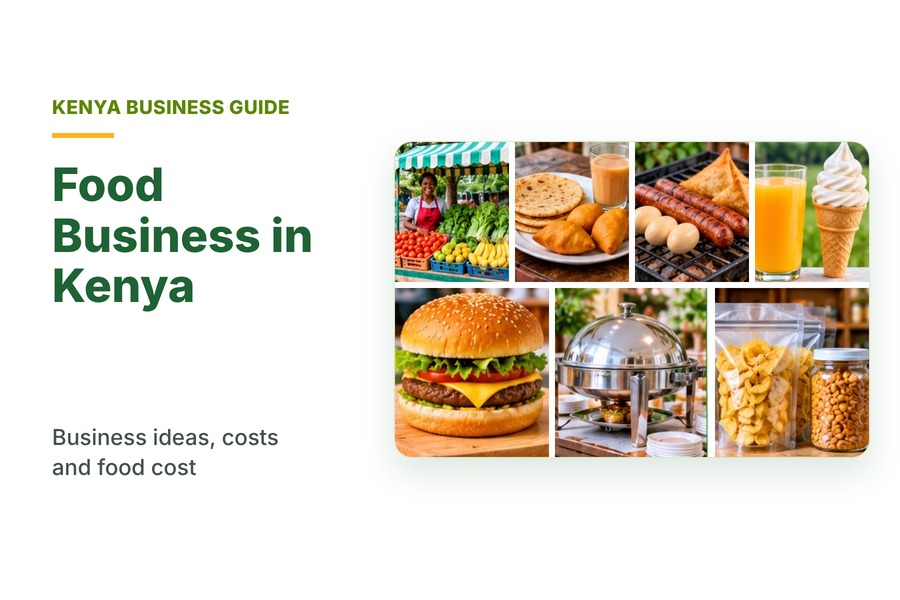
Our earlier estimates come from the Trailblazers food business guide of May 2026. They are planning ranges, not quotes. Photos are illustrative images, not pictures of real businesses.
What kiosks stock
Staples that kiosks stock
| Category | Examples |
|---|---|
| Vegetables and fruit | Sukuma wiki, spinach, cabbage, onions, tomatoes, kienyeji greens, banana, mango, avocado |
| Cereals, flours and legumes | Maize, beans, rice, green grams |
| Roots and plantains | Potato, arrow roots, yams, sweet potato, plantain |
| Baked and cooked foods | Chapati, mandazi, samosa, githeri, ugali, boiled legumes |
| Dairy, eggs and meat | Fresh milk, yoghurt, eggs, chicken |
| Fish | Tilapia, omena, dried fish |
| Drinks and spices | Tea leaves, chilli, cinnamon, turmeric, black pepper, fresh juices |
This is our stocking list, not a ranking. Walk your street and see what sells. Our kienyeji vegetables guide helps if you stock traditional greens.
Wash hands, tools and tables often. Keep raw and cooked food apart. Cook meat through. Nairobi County cited cholera risk when it tightened kiosk rules in October 2024 (The Standard).
Where to Locate a Food Business So Customers Find You
Stand where people walk, wait or work. More people passing means more first-time and repeat buyers. A clear sign or neat display pulls them in.
Go where other food sellers already cluster. A food court or a vibanda street brings shoppers who came to eat. Look first at these spots:
- 1Near office parks. Westlands, Kilimani and Upper Hill have lunch crowds.
- 2Beside transport stops. Bus stations and stages bring commuters morning and evening.
- 3Near markets and supermarkets. Shoppers buy ready food or fresh produce on the way home.
- 4Beside institutions. Colleges, hospitals and universities give steady daily demand.
Check security, access and the county rules for the spot before you pay a deposit.
Food Business Licences in Kenya: What a Kiosk, Restaurant and Factory Need
Rules differ by county and by business type. The table shows Nairobi fees we could confirm. Check NairobiPay or your own county before you pay.
Licences and fees for food businesses
| Item | What you need |
|---|---|
| Every food seller | |
| Single business permit | From KSh 4,000 a year for a kiosk under 5 square metres. Up to KSh 15,000 for a medium shop with 4 to 5 employees. Nairobi Finance Act 2026, as summarised by PayBill Kenya, updated 29 October 2026. |
| Food handler medical certificate | KSh 1,000 a certificate in Nairobi. Anyone who handles food for sale needs one (PayBill Kenya). |
| Hygiene, toilets and water | In October 2024, Nairobi County told kiosks to hold a food hygiene licence. It also wanted a kitchen with a chimney, toilets for both sexes and washing facilities (The Standard). |
| Health compliance | The 2026 Finance Act makes health, hygiene and safety compliance a condition of the business licence. |
| Fire safety certificate | Required for every business and renewed yearly (The Kenya Times). |
| Restaurants and caterers | |
| TRA restaurant licence | KSh 8,500 a year under KSh 3 million in annual receipts, plus a KSh 1,000 processing fee. Fees rise with receipts (The Kenya Times, citing KenInvest). |
| Processors | |
| KEBS S-mark | KSh 10,000 a site, up to 3 products (KEBS, KEBS FAQ). |
| Business name | KSh 250 search and KSh 950 registration (Business Registration Service). |
Fees change each year. We did not find a current Nairobi hygiene licence fee. Ask the county public health office for it.
A kiosk owner needs the permit and the handler certificate first. Add the rest as you grow into a shop, restaurant or factory.
Food Cost Percentage in Kenya: The Number That Decides Your Profit
Food cost percentage shows how much of each shilling of sales goes to ingredients. It is the first number to track if you cook and sell food.
The formula is simple: food cost % = ingredient cost divided by selling price, times 100.
Typical food cost by restaurant format
| Format | Target food cost |
|---|---|
| Quick service | 22 to 28% |
| Fast casual | 25 to 31% |
| Casual full service | 28 to 33% |
| Fine dining | 28 to 35% |
These benchmarks come from a US guide by ZoomShift. Kenyan stalls can run higher or lower. Use them as a starting point.
Illustration: a burger priced at KSh 1,200
| Item | KSh |
|---|---|
| Beef patty, 200 g | 200 |
| Burger bun | 50 |
| Lettuce, tomato and sauce | 60 |
| Total ingredient cost | 310 |
| Selling price | 1,200 |
| Food cost percentage | 25.8% |
This is an illustration from our earlier Trailblazers guide. Replace the prices with your own supplier quotes.
At 25.8%, this burger leaves room for rent, wages, gas and profit. Track the figure weekly. A rising food cost means your suppliers or your portions have changed.
- 1Buy in bulk from two suppliers. One supplier alone can raise prices without warning.
- 2Weigh portions. Fixed portions keep every plate at the same cost.
- 3Change the menu with the season. Cheap, plentiful produce lowers your cost.
- 4Count what you throw away. Waste is a cost. Cook smaller batches if you bin food daily.
What a Small Food Kiosk Earns at Your Sales and Food Cost
We model a kiosk that sells chapati, mandazi and tea. The licence fees and the food cost benchmark come from sources. Sales, waste and fixed costs are our assumptions. Replace them with your own numbers.
Assumptions for a small food kiosk
| Item | Value | Basis |
|---|---|---|
| Daily sales | KSh 5,000 | Our assumption. One Nairobi seller reported KSh 5,000 to 10,000 on a good day (K24, December 2025) |
| Food cost | 30% of sales | Our assumption, inside the 25 to 31% fast casual benchmark (ZoomShift) |
| Waste and spoilage | 5% of sales | Our assumption |
| Working days a month | 26 | Our assumption |
| Fixed costs | KSh 25,000 a month | Our assumption: rent, one helper, gas, water and licences spread over the year |
| Start-up cost | KSh 30,000 | Our assumption: the top of our earlier KSh 5,000 to 30,000 estimate |
Sales are the number to test first. They carry the most risk.
Monthly surplus by daily sales and food cost
| Daily sales | Food cost 25% | Food cost 30% | Food cost 40% |
|---|---|---|---|
| KSh 2,000 a day | KSh 11,400 | KSh 8,800 | KSh 3,600 |
| KSh 5,000 a day | KSh 66,000 | KSh 59,500 | KSh 46,500 |
| KSh 8,000 a day | KSh 120,600 | KSh 110,200 | KSh 89,400 |
| Break-even sales | KSh 1,374 a day | KSh 1,479 a day | KSh 1,748 a day |
Surplus = 26 days x sales x (1 less food cost less 5% waste), less KSh 25,000. It excludes tax, loan costs and your own pay.
Sales decide your income. At KSh 2,000 a day and 30% food cost, surplus is only KSh 8,800 a month. At KSh 5,000 it is KSh 59,500.
At KSh 5,000 a day, start-up of KSh 30,000 pays back in about 0.5 months. That holds only if you reach those sales. A weak spot or a late permit delays it.
Track daily sales for two weeks before you hire help. Cut food cost first. It is the cost you control every day.
Try your own food kiosk
Change the numbers. The result updates as you type.
A planning tool, not a quote. Surplus excludes tax, loan repayments and your own pay.
Test your food business numbers
Send us your spot, menu and prices. We will build your break-even.
Contact AgcentureCost of Starting a Food Packaging Factory in Kenya: A Snack Unit Model
Street food needs little capital. Large factories need a lot. A mid-scale snack unit sits between the two. We model a Nairobi unit that packs healthy local snacks. Think dried fruit and fortified bars for supermarkets and online buyers.
Start-up model for a mid-scale snack unit, KSh
| Item | KSh | Basis |
|---|---|---|
| A. Compliance and set-up | ||
| Company registration | 15,000 | Our assumption |
| Nairobi single business permit, small factory | 50,000 | Our assumption |
| Health and fire certificates | 20,000 | Our assumption |
| Food safety certification and testing allowance | 150,000 | Our assumption |
| Subtotal A | 235,000 | Sum |
| B. Equipment and fit-out | ||
| Mixer or processor | 300,000 | Our assumption |
| Packaging and sealing machine | 450,000 | Our assumption |
| Cold or dry store | 150,000 | Our assumption |
| Layout: tables, ventilation, fittings | 250,000 | Our assumption |
| Subtotal B | 1,150,000 | Sum |
| C. Launch and operating costs | ||
| First-month stock | 200,000 | Our assumption |
| Packaging materials | 150,000 | Our assumption |
| Lease deposit, 3 months at KSh 50,000 | 150,000 | Our assumption |
| Branding and launch | 100,000 | Our assumption |
| Staff, first month | 150,000 | Our assumption |
| Contingency | 150,000 | Our assumption |
| Subtotal C | 900,000 | Sum |
| Total start-up | 2,285,000 | A + B + C |
All lines are planning assumptions from our earlier Trailblazers model, not quotes. The KEBS S-mark fee itself is KSh 10,000 a site (KEBS). Contingency is 20% of the launch lines before it. Check machine prices in our machines guide.
Most of the money goes into equipment and launch stock. Test one product at a kiosk or stall first. Move to a unit only when buyers reorder.
Do you want to process one product line? Read our guides to milk processing, fish processing, maize milling and root crop processing. Our agro-processing guide covers the rest.
Cold chain gaps spoil perishable stock. Currency swings raise imported equipment and packaging costs. Competition is fierce, so a clear local flavour or health claim matters.
Solar Kibanda Options: Cold Storage, Light and Credit for a Food Stall
Spoilage and power cuts hurt a kibanda most. A cold box or solar fridge keeps stock fresh for more days. Lights let you trade after dark. Credit can spread the cost.
Cold storage and credit options for a kibanda
| Option | What it offers |
|---|---|
| Kool Kibanda solar stall | A stall with a solar-powered cold unit, lockable compartments and lights. The prototype cost about KSh 200,000 and rent was KSh 300 a day. Cold storage held produce up to two weeks (Africa Sustainability Matters, December 2020). |
| Koolboks solar fridge | A solar fridge with ice compartments that keeps food cool up to four days without power. Units cost US$1,500 to 3,000 with panels and battery. Pay 20 to 35% down, then up to 24 months (AllAfrica, undated). |
| Fuliza Biashara | An M-PESA overdraft for merchants, from KSh 1,000 to KSh 400,000 (TechCabal, May 2025). |
| Taasi Till | A short-term loan for small traders, from KSh 1,500 to KSh 250,000 (TechCabal, May 2025). |
These are reported terms, not quotes. We did not confirm that the Kool Kibanda stall is still on sale. Ask each provider for the current price and terms.
A cold unit pays only if it saves more stock than it costs. Count how much produce or cooked food you bin each week. Compare that with the monthly payment before you sign.
Borrow only against steady sales. Use an M-PESA till so your sales record is ready. See our agriculture finance guide first. Agcenture gives advice and does not lend.
Be careful with app-based suppliers. Twiga Foods supplied produce to small retailers. Its operating company entered administration on 17 August 2026 (Tech-ish). Keep two suppliers so one failure does not close your stall.
How to Make More Money From a Food Business: 6 Habits That Pay
- 1Keep stock cold. Cooling cuts spoilage and lets you sell more days from one purchase. See our solar cooler guide.
- 2Join a traders association. A group gives you a voice with the county. Neighbouring vendors can also buy staples together and split transport costs.
- 3Take mobile money. A Lipa na M-PESA till keeps business and personal money apart. It also builds a sales record a lender can read.
- 4Run it formally. Open a business bank account. Keep your permits current. Buyers and lenders trust formal sellers.
- 5Know your regulars. Greet them by name. Offer free packaging or chopping. Say thanks every time.
- 6Fix complaints at once. Say sorry, fix the problem and improve. Customers return to sellers who own mistakes.
If you run a kiosk beside a hotel or restaurant, you can add a takeaway window. It speeds orders, takes online orders and lines up seating. Read our agriculture finance guide before you borrow. Agcenture gives advice and does not lend.
How to Start a Food Business in Kenya in 7 Steps
- 1Do small market research. See what your street buys, who sells it and where suppliers are.
- 2Write a short business plan. List your resources, prices and cash needs. Our business plan guide shows how.
- 3Choose a good location. Check foot traffic, security and access.
- 4Register and get permits. Get the county permit, the food handler certificate and any health approvals.
- 5Open a bank account and a till. Keep business and home money apart.
- 6Build your brand. Use a bold name and a clear sign. Yellow, orange and red suit food brands. Keep the font easy to read.
- 7Buy tools and keep hygiene high. Get containers, packaging and equipment that you can wash and cover.
Once you open, stay consistent. Same taste, same price and same hours build trust and repeat sales.
Cost every plate before you sell it.
Questions Readers Ask About a Food Business in Kenya
Is a food business profitable in Kenya?
It can be when you control food cost. Our kiosk model breaks even near KSh 1,479 of sales a day.
How much do you need to start a food business in Kenya?
A vegetable kibanda can start near KSh 25,000, says K24. Fast food needs about KSh 200,000 or more, by our earlier estimate.
Which licences does a food business need?
A county single business permit and a food handler certificate. Restaurants add a TRA licence. Processors add a KEBS S-mark.
How much is a food handler certificate in Nairobi?
KSh 1,000 per certificate under the Nairobi Finance Act 2026, as summarised by PayBill Kenya.
What is a good food cost percentage?
A US guide puts quick service at 22 to 28% and casual dining at 28 to 33%. Track your own.
How much does a mama mboga make a day?
One Nairobi seller told K24 a good day brings KSh 5,000 to 10,000. The report does not say if that is sales or profit.
How much does a snack factory cost?
Our modelled mid-scale unit totals KSh 2,285,000. These are planning assumptions, not quotes.
Where is the best place for a food business?
Near office parks, transport stops, markets, supermarkets and institutions. Pick a spot with steady foot traffic.
Ready to cost your food business?
Tell us your spot, menu and prices. A farm and food adviser replies within one working day.
Written by Agcenture
We help farmers and agribusinesses across Kenya plan farms, grow profitably and reach markets. Our guides use public sources and field experience.



Very encouraging…. if incase nataka kustart my own….. can you connect with with your supplier?? Hoping to start one in Kisumu come January