In this article
Key takeaways
- Kenya landed 189,150 tonnes of fish in 2025, up 12.3%.
- Recorded fish imports were only 9,960 tonnes in 2024.
- Omena chains lose an estimated 20 to 40% of the catch.
- A solar tent dryer can dry about 150 kg of omena in a couple of hours.
- Our fillet unit needs KSh 452,200 to KSh 472,200. It breaks even near 44 kg of fish a day.
- Fish spoils by the hour. Your process must beat the clock.
Fish is the most perishable food you can sell. Kenya landed 189,150 tonnes of it in 2025. Losses after landing are high. Processing is how you keep that value.
The situation that drains your income is the heat clock. Fish warms and spoils within hours of landing. Anyone without ice, a dryer or a kiln sells cheap or throws it away.
This guide gives you three things. You see how much fish Kenya catches and how much is lost. You see five ways to process it, with listed equipment prices. You see a worked fillet unit and its break-even.
Fish spoils by the hour. Your process must beat the clock.
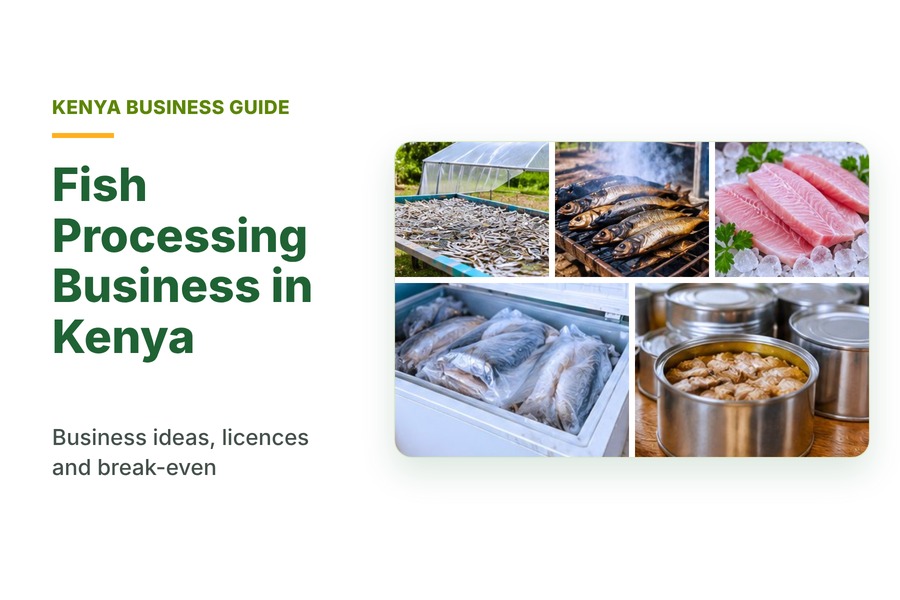
Fish processing pays when you control the cold chain and the catch. Start small with drying, smoking or fillets. Canning needs a large plant and a steady supply. We found no verified Kenyan canning cost.
Supply and losses Who processes fish Five business ideas Licences Dryer prices Worked unit Secure fish 6 steps
Is Fish Processing Profitable in Kenya? Start With Supply and Losses
Check the catch before you price a machine. The figures below show what Kenya lands, what it imports and what it loses.
Kenya fish supply, trade and losses
| Measure | Figure | Source |
|---|---|---|
| Total landings, 2025 | 189,150 tonnes, up 12.3%, worth KSh 54.9 billion | KNBS Economic Survey 2026 in BusinessPlans Kenya; Business Daily, 21 October 2026 |
| Freshwater, incl. aquaculture | 125,374.6 tonnes, 66.3% of landings | BusinessPlans Kenya |
| Lake Victoria, 2025 | 70,231 tonnes, against 94,349 tonnes in 2021 | BusinessPlans Kenya |
| Cage and pond fish, 2025 | Cage about 28,100 tonnes, up 10.1%. Pond about 6,100 tonnes, down 20.7% | BusinessPlans Kenya |
| Recorded imports, 2024 | 9,960 tonnes, down 11.5%, worth KSh 921 million. Tilapia 5,594 tonnes, mackerel 2,147 tonnes | Kenya Fisheries Service data in BusinessPlans Kenya |
| Recorded exports, 2024 | Dried small fish 3,684 tonnes. Fish fillets 1,417 tonnes | BusinessPlans Kenya |
| Shortfall estimate | About 450,000 tonnes against need | Food Business MEA |
| Post-harvest loss | Omena 20 to 40% of the catch. Lake Turkana tilapia 34% | KMFRI, 2021, in BusinessPlans Kenya |
The 450,000 tonne shortfall is far above recorded imports. It compares output with a consumption need, not with imports. Use both numbers with care.
Two facts matter for you. Output is rising, so supply exists. Losses are large, so processing has a clear job. Lake Victoria landings fell from 94,349 tonnes in 2021 to 70,231 in 2025. Check your source lake.
Kenya recorded only 9,960 tonnes of fish imports in 2024. The famous shortfall is a gap against need, not a flood of imports. Your buyers still want reliable, clean fish (BusinessPlans Kenya).
Who Processes Fish in Kenya? Small Processors and Large Players
Fish processing runs on two tiers. Small processors dry, smoke and sell near the landing site. Women make up most of the post-harvest workforce, says WorldFish. Larger firms chill, freeze and ship to supermarkets and export buyers.
The sector is large. WorldFish counts about 135,000 fishers and fish farmers and about 1.5 million fish workers in total. It puts 2023 production at about 161,300 tonnes, worth USD 280 million.
Examples of larger fish players
| Player | What the source says | Source |
|---|---|---|
| Victory Farms | Vertically integrated tilapia producer at Roo, Homa Bay. Says fish reach buyers from lake to plate within 36 hours. Lists a tilapia fillet box at KSh 995. | Victory Farms, self-reported |
| Kakamega Fish Factory | County facility in Lutonyi. An IFAD-funded programme team rated it fit for aggregation, warehousing and EU-standard export. | Kakamega County, July 2023 |
Victory Farms figures are company claims. The county article also cites a daily capacity we could not reconcile, so we left it out. This is not a full list.
WorldFish says Lake Victoria gives 80% of Kenya’s fish, with no year stated. Using 2025 KNBS figures, Lake Victoria’s 70,231 tonnes are about 37% of the 189,150 tonnes landed. Check the year behind any share you quote.
Large players compete for the same fish. Small processors win on local trust, fast turnaround and products they can make in small batches.
Five Ways to Process Fish in Kenya, From Cheapest to Most Capital
Pick the business idea that matches your catch, your cash and your buyer. Each card shows who buys and what we could price.
 1
Traders, shops and cross-border buyers.
A walk-in solar tent dryer dried about 150 kg of omena in a couple of hours (CGIAR). Dryer prices are in the table below.
You live near a landing site and handle small fish.
 2
Shops, households and hotels.
A smoking kiln smokes fish in about two hours. Smoked fish lasts up to six months (CGIAR). We found no Kenyan kiln price.
You want a low-cost product with a longer shelf life.
 3
Hotels, supermarkets and restaurants.
Shop check, Carrefour Kenya, 10 November 2026: wild tilapia fillet KSh 1,149.50 for 500 g. Nile perch fillet KSh 899.50 for 500 g, on offer. We found no Kenyan chiller price.
You have a steady supply of larger fish and a cold room.
 4
Hotels, traders and cooperatives.
A solar-powered chest freezer stores fish for several months (CGIAR). We found no Kenyan freezer price.
Your catch comes in gluts and you need to hold stock.
 5
Supermarkets and wholesalers.
Needs a heat-treatment line and a large, steady catch. Recorded canned-fish imports are small. We found no verified Kenyan canning cost.
You have export-scale volume and capital. Start with ideas 1 to 3.
Retail prices are shop prices, not what a processor receives. Treat them as a ceiling.
Do not waste the by-products. Skins can become leather. Read how in our fish leather guide. Heads and frames can go to feed makers, but we found no Kenyan price.
Fish spoils fast and can carry disease. Gut and chill it at once. Keep raw and cooked fish apart. Wash tools and tables after each batch. Confirm the standards you must meet with the Kenya Fisheries Service and KEBS.
Fish Processing Licences in Kenya: What a Small Plant and an Exporter Need
Kenya Fisheries Service rules apply to processing plants. The steps below come from the Streamline Feed report of 17 October 2026 on the regulations. The KeFS import and export page lists similar documents.
Licences and approvals for fish processing
| Item | What you need |
|---|---|
| Every processing plant | |
| Facility approval | Director-General approval on Form KeFS/FS/A2 before you build or refurbish. An inquiry receipt is not approval. |
| County licence | A county licence, plus competent-authority approval. Confirm the fee with your county. |
| Fish-processing licence | Issued after the Director-General inspects the site. |
| Exporters | |
| Certificate of compliance | Needed for each export product line, renewed yearly. KeFS charter lists KSh 35,000 per product line. |
| Export permit | Valid 14 days for fresh fish and 21 days for other products. One per consignment. |
| Sanitary health certificate | Issued after inspection, for each export consignment. |
| Business basics | |
| Business name | KSh 250 search, KSh 950 registration (Business Registration Service) |
| County business permit (Nairobi) | KSh 5,000 to 25,000 (Business Plans Kenya, September 2026) |
| Food handler certificate (Nairobi) | KSh 1,000 (PayBill Kenya) |
| KEBS S-mark | KSh 10,000 a site, up to 3 products (KEBS, KEBS FAQ) |
The report says the law sets separate fees for the processing licence, health certificate and export permit. It gives no amounts. Ask KeFS for the current schedule.
Ask KeFS whether a cottage drying or smoking unit needs the full processing licence. Rules differ by product and by buyer. A written answer protects you.
Solar Fish Dryer Prices in Kenya: What Drying Equipment Costs
One Kenyan supplier, Aquahub Kenya, lists dryers by size and frame. The page dates from December 2023 and was updated in July 2024. It does not state the currency, but its other prices are in KSh.
Solar dryer prices by size
| Size | Capacity | Wooden frame | Steel frame |
|---|---|---|---|
| 1.5 x 1.5 x 1.5 m | 40 to 50 kg | KSh 55,000 | KSh 105,000 |
| 2 x 2 x 1.5 m | 50 to 100 kg | KSh 75,000 | KSh 120,000 |
| 2 x 2 x 2 m | 90 to 130 kg | KSh 85,000 | KSh 140,000 |
| 3 x 2 x 2 m | 150 to 180 kg | KSh 90,000 | KSh 153,000 |
These are older listed prices. The page gives no drying time for fish. Confirm with your own trial and get two more quotes.
A steel frame costs KSh 35,000 to 65,000 more than wood at each size. Choose wood to start. Move to steel when your volume proves itself.
Dry fish only once you know your buyer. Kenya exported 3,684 tonnes of dried small fish in 2024. The DRC took 3,497 tonnes of all fish-product exports.
What a Small Fillet Unit Earns at Your Price and Volume
We model a cottage unit that fillets whole tilapia for hotels. Only the licence fees and the retail checks come from sources. Everything else is our assumption. Replace it with your own numbers.
Assumptions for a cottage fillet unit
| Item | Value | Basis |
|---|---|---|
| Fit-out | KSh 400,000 | Our assumption: chest freezers, tables, scales, knives, packaging and a chilled room |
| KeFS certificate, one product line | KSh 35,000 | KeFS charter, as reported |
| KEBS S-mark | KSh 10,000 | KEBS |
| Name, food handler and county permit | KSh 7,200 to KSh 27,200 | Fees table above |
| Start-up total | KSh 452,200 to KSh 472,200 | Sum of the rows above |
| Whole fish bought | KSh 350 a kilo | Our assumption. We found no verified farm-gate price |
| Fillet yield | 35% of whole weight | Our assumption. Weigh your own batch |
| Packing, ice and power | KSh 30 per kilo of fish | Our assumption |
| Share sold | 95% | Our assumption. The rest is waste and returns |
| Staff, rent and delivery | KSh 60,000 a month | Our assumption |
| Working days a month | 26 | Our assumption |
Shop prices were KSh 2,299 a kilo for wild tilapia fillet. Nile perch fillet on offer was KSh 1,799. Hotels pay less than shops.
Monthly surplus by fillet price and daily volume
| Daily volume | KSh 1000 a kilo | KSh 1300 a kilo | KSh 1600 a kilo |
|---|---|---|---|
| 50 kg of fish a day | -KSh 121,750 | KSh 7,925 | KSh 137,600 |
| 100 kg of fish a day | -KSh 183,500 | KSh 75,850 | KSh 335,200 |
| 200 kg of fish a day | -KSh 307,000 | KSh 211,700 | KSh 730,400 |
| Break-even volume | Never | 44 kg a day | 15 kg a day |
Surplus = days x kilos x (yield x price x 0.95 less KSh 380) less KSh 60,000. A negative result means a loss. It excludes tax, loan costs and owner pay.
Price decides whether you can win. At KSh 1,000 a kilo of fillet, you lose on every kilo of fish. At KSh 1,300, you break even near 44 kg of fish a day.
At 100 kg of fish a day and KSh 1,300, surplus is KSh 75,850 a month. Start-up then pays back in about 6.0 to 6.2 months. That holds only if hotels pay that price and you hit a 35% yield.
Yield and fish price move the result the most. Run a 20 kg trial before you buy freezers. Ask three hotels for a firm price in writing.
Try your own fillet unit
Change the numbers. The result updates as you type.
A planning tool, not a quote. Surplus excludes tax, loan repayments and owner pay.
Test your fish processing numbers
Send us your lake or coast site, your catch and your buyers. We will build your break-even.
Contact AgcentureHow to Secure Fish Supply When Catches Swing
Catches swing with season, rules and fuel prices. In Homa Bay in October 2023, a fishing suspension and dear fuel doubled fresh omena prices. A 2 kg tin rose from KSh 300 to KSh 600 (The Star). That price swing is your supply risk.
- 1Sign cage farmers. Cage output was about 28,100 tonnes in 2025. Agree volume, size and price in writing. See contract farming and our fish farming guide.
- 2Work with landing-site groups. Agree a price formula and a payment day with beach groups and cooperatives.
- 3Hold stock when catches are high. Freeze or dry gluts. A solar freezer holds fish for months (CGIAR).
- 4Use more than one species. Mix tilapia, Nile perch and small fish so one closure does not stop you.
Chill near the landing site. Cold storage close to the catch cuts losses. Our solar cooler guide explains the basics of solar cooling.
How to Start a Fish Processing Business in Kenya in 6 Steps
- 1Pick one business idea and one product. Start with dried fish, smoked fish or fillets.
- 2Name your buyers. Get three hotels, shops or traders to state a price and weekly volume.
- 3Lock in the fish. Agree supply with farmers or landing groups, with a plan for closed seasons.
- 4Ask KeFS what you need. Request the facility approval and licence steps in writing.
- 5Run a 20 kg trial. Weigh fish in and product out. Measure your own yield and loss.
- 6Write the numbers down. Put the calculator results in a farm business plan. Our agro-processing guide covers other products.
Read our agriculture finance guide before you borrow. Agcenture gives advice and does not lend. Our food business guide covers labels and shelf buyers.
Fish spoils by the hour. Your process must beat the clock.
Questions Readers Ask About Fish Processing in Kenya
Is fish processing profitable in Kenya?
It can be. Value comes from beating spoilage. Our fillet unit breaks even near 44 kg of fish a day.
How much does it cost to start a fish processing business in Kenya?
Our cottage fillet unit needs KSh 452,200 to 472,200. Most of that is our fit-out assumption. Drying costs less.
How much is a solar fish dryer in Kenya?
One supplier lists wooden dryers from KSh 55,000 to 90,000 and steel from KSh 105,000 to 153,000. Capacity runs from 40 to 180 kg.
Which licence do you need to process fish in Kenya?
Kenya Fisheries Service facility approval and a processing licence, plus a county licence. Exporters add a certificate of compliance.
How long does smoked fish last?
Up to six months, according to a CGIAR project in Homa Bay County. Smoking took about two hours.
Is fish canning profitable in Kenya?
We found no verified Kenyan canning cost. It needs large volumes and capital. Start with drying, smoking or fillets.
Who are the major fish processors in Kenya?
Victory Farms and Kakamega Fish Factory are two examples. Many small processors dry and smoke fish at landing sites.
How much fish does Kenya produce?
Kenya landed 189,150 tonnes in 2025, up 12.3%. Recorded imports were 9,960 tonnes in 2024.
Ready to size your fish unit?
Tell us your site, catch and buyers. A farm adviser replies within one working day.
Written by Agcenture
We help farmers and agribusinesses across Kenya plan farms, grow profitably and reach markets. Our guides use public sources and field experience.