Key takeaways
- Shangi is the most popular variety, but sprouts within a month.
- Unica is early and high yielding; Dutch Robijn stores longest.
- Markies and Challenger suit chips; Dutch Robijn and Sherekea suit crisps.
- Stated potentials run from 12 to 22 tonnes an acre.
- Farms average about 4 tonnes, whatever the variety.
- Confirm certified seed is available before you choose.
Eight of every ten potatoes grown in Kenya are one variety.
Shangi earned that place by maturing fast and selling everywhere. It is not the best choice for every buyer.
This guide ranks ten varieties, then compares 25 by altitude, maturity, yield, dry matter and dormancy.
Grow Shangi for the open market. Grow Markies or Challenger under a chips contract, and Dutch Robijn or Sherekea for crisps. Choose Unica for early, high yields, and Dutch Robijn or Sherekea if you plan to store.
Six Questions That Pick Your Potato Variety
Ask who buys it, then check altitude, maturity, blight tolerance, storage life and seed availability.
Shangi
Fast, familiar and bought by every broker.
Markies, Challenger, Shangi
Long tubers with high dry matter.
Dutch Robijn, Sherekea
Round tubers, shallow eyes and long dormancy.
Dutch Robijn, Sherekea, Manitou
Dormancy of three and a half months or more.
Unica, Kerr’s Pink
Early, and tolerant of heat or dry spells.
Sherekea, Asante
Tolerant of late blight.
Kenya has more than 50 catalogued potato varieties (NPCK catalogue). Most farms need one or two.
Seed availability decides more than the catalogue. Confirm you can buy certified seed before you choose.
Choose the potato your buyer cooks. Then check that it suits your altitude.
The Top 10 Best Potato Varieties in Kenya
Shangi, Unica, Sherekea, Manitou and Kenya Mpya are the top five. Dutch Robijn, Markies, Tigoni, Asante and Kenya Karibu complete the ten.
- 1Shangi.The market leader. Matures in about three months, but sprouts within a month.
- 2Unica.Early and high yielding, with tolerance to heat.
- 3Sherekea.Many tubers a plant, blight tolerance and long storage.
- 4Manitou.Red skin, pale yellow flesh and big tubers for chips, mash and stews.
- 5Kenya Mpya.Blight resistant, with good storability and suitability for fries.
- 6Dutch Robijn.The crisps variety, with dormancy of up to four and a half months.
- 7Markies.A late processing variety for chips, with 23 per cent dry matter.
- 8Tigoni.A table and chips variety released in 1998.
- 9Asante.Pink-skinned, high in dry matter and blight tolerant.
- 10Kenya Karibu.Deep red skin and yellow flesh, with long dormancy.
The first five are the most widely grown (The Organic Farmer). The rest is our judgement.
It weighs market demand, seed availability, yield and storage life.
High Yielding Potato Varieties in Kenya: Which Leads?
On the national list, Farida at 55 tonnes a hectare and Zarina at 50. Among common varieties, Unica leads at over 45.
Farms average about 10 tonnes a hectare, whatever the variety (Food Business MEA).
Seed health and management explain the gap, not genetics.
Older guides gave Shangi 30,000 to 40,000 kg an acre. The figure is tonnes a hectare, or 12 to 16 tonnes an acre.
All 25 Compared: Altitude, Yield and Dormancy
Altitude, maturity, yield potential, dry matter and tuber dormancy for 25 registered varieties.
Ten leading varieties
| Variety | Altitude (m) | Maturity | Yield potential, t/acre | Dormancy |
|---|---|---|---|---|
| Shangi | 1,500 and above | Up to 3 months | 12 to 16 | Under 1 month |
| Unica | 1,400 to 3,500 | 2.5 to 3.5 months | Over 18 | 2.5 to 3.5 months |
| Dutch Robijn | 1,800 to 2,600 | 3 to 4 months | Up to 12 | 3.5 to 4.5 months |
| Markies | 1,300 to 3,000 | Over 4 months | Over 16 | Over 2 months |
| Tigoni | 1,800 to 2,600 | 3 to 4 months | 14 to 18 | 2 to 3 months |
| Asante | 1,800 to 2,600 | 3 to 4 months | 14 to 18 | 2 to 3.5 months |
| Sherekea | 1,800 to 3,000 | 3 to 4 months | Over 16 | 4 to 4.5 months |
| Kenya Mpya | 1,400 to 3,000 | 3 to 4 months | 14 to 18 | 2.5 to 3 months |
| Kenya Karibu | 1,800 to 2,800 | 3 to 4 months | 12 to 14 | 3.5 months |
| Kenya Mavuno | 1,800 to 2,800 | Over 4 months | 12 to 16 | 2.5 to 3 months |
Figures from the national variety list, as published in the potato variety catalogue. Potentials, not farm averages.
See all 25 varieties with dry matter
Twenty-five potato varieties
| Variety | Altitude (m) | Maturity | t/ha | t/acre | Dry matter | Dormancy |
|---|---|---|---|---|---|---|
| Shangi | 1,500 and above | Up to 3 months | 30 to 40 | 12 to 16 | 21.4% | Under 1 month |
| Unica | 1,400 to 3,500 | 2.5 to 3.5 months | Over 45 | Over 18 | 21.0% | 2.5 to 3.5 months |
| Dutch Robijn | 1,800 to 2,600 | 3 to 4 months | Up to 30 | Up to 12 | 21.6% | 3.5 to 4.5 months |
| Markies | 1,300 to 3,000 | Over 4 months | Over 40 | Over 16 | 23.0% | Over 2 months |
| Tigoni | 1,800 to 2,600 | 3 to 4 months | 35 to 45 | 14 to 18 | 21.4% | 2 to 3 months |
| Asante | 1,800 to 2,600 | 3 to 4 months | 35 to 45 | 14 to 18 | 21.3% | 2 to 3.5 months |
| Sherekea | 1,800 to 3,000 | 3 to 4 months | Over 40 | Over 16 | 21.3% | 4 to 4.5 months |
| Kenya Mpya | 1,400 to 3,000 | 3 to 4 months | Over 40 | 14 to 18 | 23.0% | 2.5 to 3 months |
| Kenya Karibu | 1,800 to 2,800 | 3 to 4 months | 30 to 35 | 12 to 14 | 21.4% | 3.5 months |
| Kenya Mavuno | 1,800 to 2,800 | Over 4 months | 30 to 40 | 12 to 16 | 21.2% | 2.5 to 3 months |
| Wanjiku | 1,500 to 3,500 | 3 to 4 months | Over 40 | Over 16 | 21.0% | Over 3 months |
| Nyota | 1,500 to 3,500 | 3 to 4 months | Over 40 | Over 16 | 20.0% | 2.5 to 3 months |
| Lenana | 1,500 to 3,500 | 3 to 4 months | Over 40 | Over 16 | 22.0% | 2 to 3 months |
| Chulu | 1,500 to 3,500 | 3 to 4 months | Over 40 | Over 16 | 24.0% | 2.5 to 3 months |
| Konjo | 1,600 to 3,500 | 3 to 4 months | Over 40 | Over 16 | 19.0% | 2.5 to 3 months |
| Desiree | 1,800 to 2,600 | 2.5 to 3.5 months | 35 to 40 | 14 to 16 | 21.0% | 1 to 2 months |
| Kerr’s Pink | 1,400 to 2,700 | Up to 3 months | Under 30 | Under 12 | 20.0% | 2 to 3 months |
| Purple Gold | 1,800 to 3,000 | 3 to 4 months | Under 30 | Under 12 | Not listed | 4 to 4.5 months |
| Destiny | 1,500 to 3,000 | 3 months | 30 to 40 | 12 to 16 | 24.0% | 1 to 2 months |
| Jelly | 1,300 to 3,000 | Over 4 months | Over 40 | Over 16 | 21.0% | 1 to 2 months |
| Manitou | 1,300 to 3,000 | Over 4 months | Over 40 | Over 16 | 19.3% | Over 4 months |
| Challenger | 1,300 to 3,000 | Over 4 months | Over 40 | Over 16 | 22.0% | 1 to 2 months |
| Caruso | 1,300 to 3,000 | 3 to 4 months | 25 to 35 | 10 to 14 | 25.5% | 1 to 2 months |
| Zarina | 1,300 to 3,000 | 3 to 4 months | 50 | 20 | Not listed | Under 1 month |
| Farida | 1,300 to 3,000 | 3 to 4 months | 55 | 22 | Not listed | 2 months |
Dry matter matters to processors. Higher dry matter gives crisper chips that absorb less oil.
Dormancy matters to anyone who stores. Short dormancy means early sprouting.
The Best Potatoes for Chips, Crisps and Mashing
Markies, Challenger and Shangi for chips. Dutch Robijn and Sherekea for crisps. Tigoni, Chulu and Jelly for mashing.
Chips
Long tubers, high dry matterMarkies, Challenger, Shangi and Laura.
Processors usually contract Markies.
Crisps
Round tubers, shallow eyesDutch Robijn, Sherekea and Royal.
Long dormancy keeps tubers unsprouted for slicing.
For mashing and boiling, choose floury white or yellow-fleshed types such as Tigoni, Chulu, Annet and Jelly.
Red-skinned Asante, Desiree and Kerr’s Pink sell to buyers who ask for red potatoes.
Shangi Potato Variety: The Most Popular, and Where It Fails
Shangi is the most popular potato variety in Kenya. It matures in about three months, but is prone to blight and sprouts fast.
Estimates of its share run from 70 per cent (Crop Trust) to 85 per cent (CGIAR).
Its tubers are oval, with cream skin, white flesh and pink-tinged eyes. They suit boiling, mashing and chips.
Short dormancy is a strength for replanting and a weakness for storage.
In wet seasons it needs frequent fungicide. Budget for that before you plant.
Unica: The Early, Heat-Tolerant Alternative
Unica matures in about three months and tolerates heat and dry spells. Its stated potential is above 18 tonnes an acre.
Its tubers are oblong, with red skin and cream flesh. They suit chips, crisps and table use (The Organic Farmer).
It grows from 1,400 to 3,500 metres, a wider band than most varieties.
Dormancy of about three months lets you store it longer than Shangi.
Which Potato Variety Keeps the Longest?
Dutch Robijn, Sherekea and Purple Gold, at up to four and a half months of dormancy. Manitou stores for over four.
Dormancy is the time before a harvested tuber sprouts. It sets how long you can wait for a better price.
Short dormancy has one use. You can replant the same seed sooner.
How to Identify Potato Varieties by Sight
Check four things: skin colour, flesh colour, tuber shape and the colour of the eyes.
Telling common varieties apart
| Variety | Skin | Flesh | Shape |
|---|---|---|---|
| Shangi | Cream, with pink eyes | White | Oval |
| Unica | Red | Cream | Oblong |
| Sherekea | Red | Cream | Round |
| Manitou | Red | Pale yellow | Large, oval |
| Kenya Mpya | Cream | Cream | Oval |
| Kenya Karibu | Deep red | Yellow | Oval |
| Asante | Pink | Cream | Round |
| Purple Gold | Purple | Yellow | Round |
Descriptions from The Organic Farmer, FarmBiz Africa and the national catalogue.
What are the main types of potatoes?
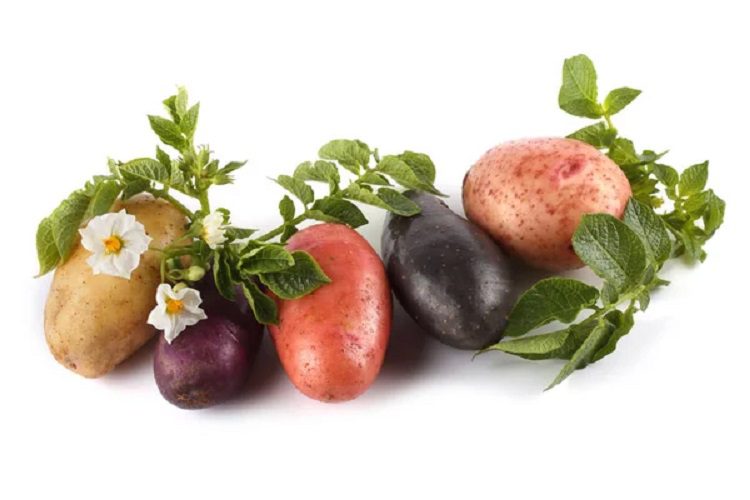
Cooks worldwide group potatoes into seven types: russet, red, white, yellow, purple, fingerling and petite.
Kenyan markets trade mainly white or cream, red and yellow types. Purple Gold is the purple one.
Tubers alone can mislead. A certified seed label is the only proof of variety.
New Potato Varieties in Kenya: Malaika, Glen and Arizona
Malaika and Glen joined the national list in July 2025. Both resist potato cyst nematode.
Nematode resistant
Short dormancy and fast cooking, with processor approval.
Nematode resistant
Bred with Malaika for Kenyan growers’ preferences.
Early, about 95 days
Yellow skin, with heat and drought tolerance.
Malaika and Glen passed the national trials and were approved by processors (FreshPlaza).
Arizona is sold by Agrico East Africa, whose page lists its commercial varieties.
Seed of new varieties is scarce at first. Ask the seller about volumes before you plan an acre.
Where to Find Seed of Each Variety
Public varieties come from KALRO Tigoni and ADC Molo. Dutch varieties such as Markies come from their licensed seed companies.
Publicly bred varieties, such as Shangi, Unica and Sherekea, can be multiplied by any registered producer.
Protected varieties need the breeder’s permission, so only named companies sell them.
A KALRO potato seed price list is not published in one place. Guides quote KSh 3,000 to 3,700 a 50 kg bag in 2026.
Producers, seed classes and 2026 prices are listed in the potato seed business in Kenya.
Want the potato varieties in Kenya as a PDF? Download the NPCK potato variety catalogue.
Variety Mistakes That Cost a Season
Choosing on yield alone, planting a processing variety without a contract, and storing a short-dormancy variety.
Do this
- 1Ask the buyer which variety they take
- 2Match the variety to your altitude
- 3Confirm certified seed is available
- 4Trial a new variety on a small plot
Avoid this
- 1A processing variety with no contract
- 2Shangi for long storage
- 3Seed of unknown origin
- 4One variety on every plot, every season
Choose the potato your buyer cooks. Then check that it suits your altitude.
After You Choose
Order certified seed early, then plan the acre.
Budget the crop with potato farming in Kenya.
Planting months and fertiliser for tuber size are in how to grow potatoes in Kenya.
Planning a potato enterprise?
Agcenture prepares crop budgets, market checks and farm business plans. Tell us your county and acreage.
Written by Agcenture
Agcenture helps Kenyan farmers and food businesses plan, finance and grow. Our guides use public sources and clearly labelled assumptions.
Questions readers ask
Which is the best potato variety in Kenya?
Shangi for the open market. Markies for chips contracts, Dutch Robijn for crisps and Unica for early, high yields.
What are the top 10 potato varieties in Kenya?
Shangi, Unica, Sherekea, Manitou, Kenya Mpya, Dutch Robijn, Markies, Tigoni, Asante and Kenya Karibu.
Which potato variety has the highest yield in Kenya?
Farida and Zarina have the highest stated potentials. Among common varieties, Unica leads at over 18 tonnes an acre.
Which potatoes are best for chips in Kenya?
Markies, Challenger and Shangi.
Which potato variety matures fastest?
Shangi, Kerr’s Pink and Unica mature in about three months or less.
What is the most popular potato variety in Kenya?
Shangi, with 70 to 85 per cent of production.
What potato variety keeps the longest?
Dutch Robijn, Sherekea and Purple Gold, at up to four and a half months.
What are the new potato varieties in Kenya?
Malaika and Glen, listed in July 2025, and Arizona.
How many potato varieties are there in Kenya?
More than 50 are catalogued.



Are there potato varieties that take 2 months to reach maturity and begin harvesting?