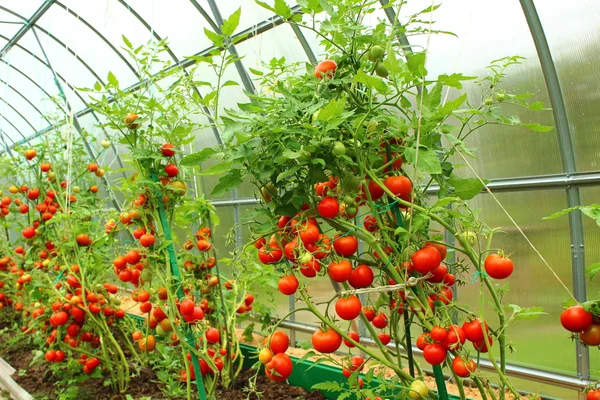
Are you wondering the amount of money you can make in greenhouse tomato farming in Kenya? In analysis learn how to calculate your profits and costs for growing tomatoes in a standard 30 by 8 green house.
Benefits of greenhouse farming
In comparison to open cultivation method, Greenhouse farming has following benefits or advantages; –
- Get more yields due to optimal climate conditions and growing more plants per square foot than growing crops in open field.
- Redice cost of production, in protected agriculture, your green house will keeps your crops from adverse weather, pests and diseases that may harm them.
- You will earn more profits from greenhouse farming compared to open field farming.
- You can use hydroponics and utilize resources more efficiently as you reduce other wastes such as farm chemicals and weeding labor.
- you can grow crops all the year round instead of seasonal production, unlike open cultivation, you do not have to rely on conducive weather,
- You can automate operations in your greenhouse production by use of sensors and data to monitor climate conditions and machinery to do basic menial tasks. You can therefore increase yields reduce labor, costs and resources.
Read Next : How profitable is open field Tomato farming in Kenya?
How profitable is tomatoes growing in a greenhouse?
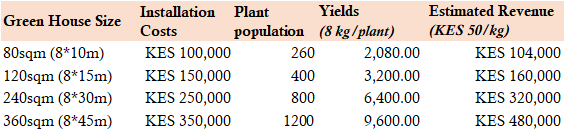
How much money can you make by growing tomatoes in greenhouses? In this analysis, we will consider the costs and income for growing the crops in an 8*30 or a 240 sqm greenhouse. The analysis makes the following assumptions for the profit’s estimates.
Assumptions
- This profit analysis assumes a constant selling price of KES 50 for a Kg of tomatoes throughout the harvesting period.
- The prices of inputs remain same the crop growing period.
- The tomato crop season lasts 55 weeks in a greenhouse.
Detailed Revenue analysis.
To get the projected revenues, get the product of the average yields in and the assumed selling price per kilogram above.
Yields and sales revenue.
Are you wondering how much revenue you can make from growing tomatoes in a greenhouse? The following figure is a summary of money you can make before growing and marketing costs.
It assumes each plant will yield an average of 8Kg. The crop population in the greenhouse or growth panel uses an area of 240 sqm divided by the recommended spacing of 50*60 cm. For instance, the standard greenhouse sized 8*30metres will house 800 tomato crops. Therefore, you will harvest 6400 kgs of tomatoes or 800 plants*8 kg.
You will make KES 320,00O by growing tomatoes in a green house before costs. It is after selling all yields of 6.4 tons at prevailing price of KES 50 per kg.
Detailed Cost analysis
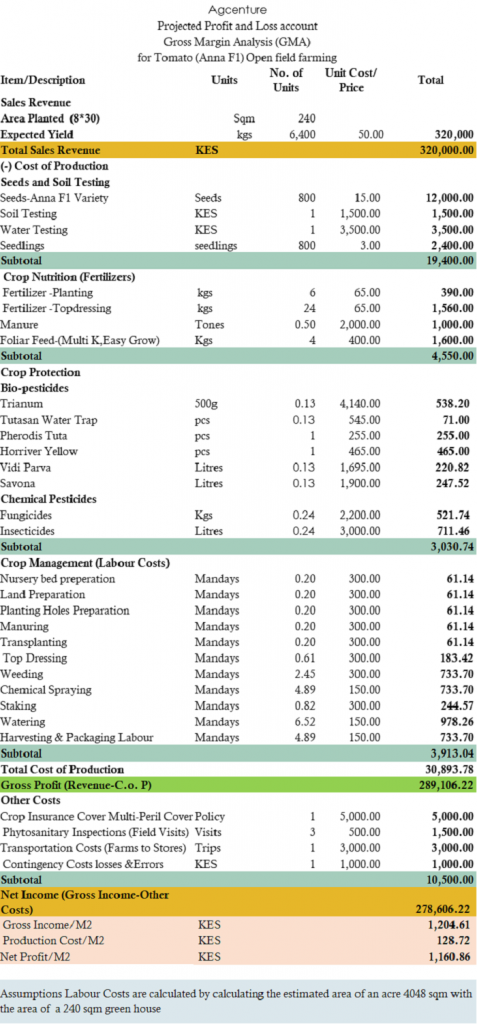
Growing tomatoes in a 240 sqm greenhouse will cost you KES 30,893. This excludes the cost of initial greenhouse installation as shown in the figure above. The detail of these expenses for the tomato farming in Kenya in a greenhouse are as follows: –
Best Tomato Varieties for greenhouse farming
There are several indeterminate tomato seed varieties you can grow in a greenhouse in Kenya. Agcenture recommends use of a certified hybrid or F1 seeds. They are more resistant to disease and has higher yields. The table below is a summary of 5 of indeterminate tomato seeds for sale from leading seed companies in Kenya. They are Anna F1, Nemoneta, Prosta F1 and Tylka F1 It shows the maturity period from transplanting and the yields in Kg per acre.
| Seed Variety | Maturity period (days) | Yields (Kg/plant) |
| Anna F1 | 75 | 35 |
| Nemoneta | 69-80 | 18-27 |
| Prostar F1 | 80-85 | 12 |
| Tylka F1 | 90 | 70,000-78,000 per acre* |
This analysis is for the anna F1 variety. The price of tomato seeds in Kenya is Ksh. 15 per seed. You will spend Ksh 12,000 for 800 seeds to fill the 240 sqm greenhouse. You can prepare your own seed nursery, use planting trays to raise seedlings or buy certified seedlings from a plant raiser. They usually charge KES 3 for one.
Read Next; Best tomato varieties in kenya
Greenhouse preparation
The cost of installing 240 sqm greenhouse is KES 250,000. These include prices for installing a 500-litre irrigation water tank and a drip irrigation kit. The tank will serve the plants for a single day at a half a litre per plant per day.
Other costs for greenhouse installation are putting up stakes and strings to train tomatoes.
In addition, you will incur expenses for soil and water testing. Tomatoes require well drained soils with a pH value of 6.0-7.5. You should use portable clean water for irrigation. While you can contract ab agrovet for soil testing, it’s cheaper to buy your own soil tester or water testers online.
Transplanting
Transplant your Anna F1 tomato seedlings in 2-3 weeks from sowing. The recommended spacing is 30-40 cm intra row by 1.2 – 1.5cm inter row.
Transplanting is best done in the evening when the weather is cool.
Best Fertilizers for tomato planting and top dressing
To prepare the greenhouse planting ground, apply half a ton of well decomposed farmyard manure. The recommended application rate is 6 kg of planting fertilizer such as the DAP or TSP. The blend should be a recommendation of the soil analysis results.
Tomato is a heavy feeder; you will need to use 24 kg of top-dressing fertilizer. The first is done with a CAN or urea at 4 weeks after transplanting. The second tomato top dressing is done on the 8th week with a compound fertilizer like the NPK.
To keep the tomato crop more vegetative and productive, apply a foliar fertilizer during flowering and fruiting period to promote vegetative bloom.
Staking, pruning and training.
Anna F1 is an indeterminate variety meaning it has vigorous growth. When its mature, it grows to approximately 2 m long or the height of a normal adult. You need to support, prune and train it to reduce moisture accumulation, allow free air movement and reduce disease and pest incidences.
To stake the plant, insert trails into the soil just adjacent to the tomato and a trellis or string tied on to it and then tied on the barbed wire above. The tomato is then made to wind on
the string upwards.
Tomato plants in a greenhouse are pruned to a single stem. All lateral branches or suckers must be removed when they are one to three inches long. You will have to remove side shoots, laterals, old leaves, diseased leaves & branches and overshadowed lower leaves by hand.
Pests and disease management
Tomato needs a robust crop protection program to keep it healthy and ensure high yields. The common tomato pests are Aphids, thrips, whiteflies, cutworms, bollworms, leaf miners, spider mites and nematodes. The worst diseases include Wilts, Blight, Leaf spots and mildews.
Since the Anna F1 tomato is protected in a greenhouse, the cost of crop protection is cheaper than open field. Besides, you can use bio-pesticide products only helping you to grow organic products. You can sell them at a premium price than conventional tomatoes in the market giving you more profits.
Labour costs
The labour costs to grow greenhouse Anna F1 tomatoes is more expensive than open field. The estimated average labour requirement for 24- by 96-foot (8*30m) greenhouse is 20 person-hours per week on average. You need the extra work for pruning, wrapping, pollinating, spraying, etc.
The cost estimates to raise tomatoes in a 240sqm is KES 4000. The figures are for an automated greenhouse operation. More time is needed during crop management and harvesting.
Harvesting
Anna F1 tomato fruits are ready for harvest in 70-75 days. It can continue for up to 6-8 months. You are to observe the recommended pre-harvest period if you have sprayed a chemical pesticide recently.
After harvesting, grade and sort them using size, colour and weight.
Gross margin analysis for tomato farming
How profitable is tomato farming in greenhouses? According to this analysis, you will make a gross profit of KES 289,000 from a 240 sqm greenhouse in one season of 55 weeks. As outlined, you will subtract KES 31,000 total costs from the expected sales revenue of KES 320,000.
To get your net profits, subtract KES 10,500 of other costs like insurance, field visits, transport and contingency losses. You will therefore pocket around KES 278,000.
Bonus tips for greenhouse tomato farming
For more efficient profitable commercial tomato farming, you can observe following ideas to make more profits.
- Automate greenhouse farming operations like remote pest and disease inspection, automated irrigation and chemical spraying to reduce costs of labour.
- Engage in contract farming to lock a stable selling price with a buyer throughout the harvesting period.
- Invest in tomato value addition to make tomato jams, sauce and pickles to earn more profits. Other more cheaper methods are tomato roasting and sun drying. Value addition apart from increasing farmer income, helps to manage food waste, one of major challenges for horticulture farmers.
Did you Like the Post? Let us know below
Agcenture.com is your best agriculture, food & health blog.
Thank you for following us on Facebook, Twitter (X), LinkedIn, YouTube, and WhatsApp @ Agcenture for the latest updates.

Am happy to get this information, I need a company that can hold my hand so that we walk together for me to succeed, am at Kakamega I need annah f1 seedlings where can I get them?