Key takeaways
- SOP in full is standard operating procedure: the written steps for one job.
- Use one form with seven parts, and keep each SOP to one page.
- Start with the three jobs where a mistake costs most: often spraying, milking and buying.
- When a job fails, ask why five times, then fix the SOP.
- An operations manual holds your SOPs, policies, forms and organisation chart.
A farm SOP is a written standard operating procedure for one job. It gives numbered steps, the person responsible and the record to fill. Write one for each job where a mistake costs money, health or a customer. Keep it to one page, test it on a new worker, and review it yearly.
You are away for a week. A new worker mixes the spray by guess, and the milker waits for a can that never comes. Nothing was written down, so nobody did anything wrong.
If the job lives in one person’s head, the farm stops when that person does.
What is an SOP? Meaning in business and on a farm
SOP in full is standard operating procedure. It is a written, step-by-step way of doing one job, so everyone does it the same way.
A policy
States a rule. “No visitor enters the pig unit without overalls and a foot dip.”
An SOP
Shows how. The steps a worker follows when a visitor arrives at the gate.
A manual
Holds them all. Policies, SOPs, forms and the organisation chart in one file.
In business, an SOP means the job no longer lives in one person’s head. On a farm, that person is usually you.
A good SOP fits on one page and uses your workers’ own words. It names the record to fill when the job is done.
When does a farm need written SOPs? 5 signs
Write an SOP when a mistake in the job costs money, health or a customer. Five situations call for one.
- 1More than one person does the job. Two milkers with two methods give you two qualities of milk.
- 2You are often away. The farm should run the same on the days you are not there.
- 3Staff change. A new worker learns from the page, not from the last worker’s habits.
- 4A buyer or certifier audits you. Auditors ask for written procedures as well as farm records.
- 5The same mistake keeps happening. A repeated error means the method is unclear, not that the worker is careless.
Do not write one for every task. Start with the three jobs where an error hurts most.
The standard operating procedure form: 7 parts on one page
Seven parts, on one page. Use the same form for every SOP, so workers know where to look.
| Part | What to write | Example: spraying |
|---|---|---|
| 1. Title and number | A plain name and a code | SOP 03: Spraying a crop |
| 2. Purpose | One sentence on why the job matters | To control pests safely and keep produce within residue limits |
| 3. Scope | Where and when it applies | All sprays on all fields |
| 4. Who | The person who does it, and who checks | Spray operator. Checked by the farm manager. |
| 5. What you need | Tools, materials and protective gear | Sprayer, product, measuring jug, gloves, mask, overalls, boots |
| 6. Steps | Numbered actions, one per line, starting with a verb | See the first example in the next section |
| 7. Record and review | The record to fill, the date written and the next review | Spray record. Written November 2026. Review in a year. |
Start every step with a verb: wash, weigh, record. If a step needs “and”, split it in two.
6 farm SOP examples to copy
Six one-page procedures cover the jobs where farms lose most. Adapt the steps to your farm, with your vet or agronomist.
Spraying a crop
Purpose: to control the pest safely, and keep the harvest within residue limits.
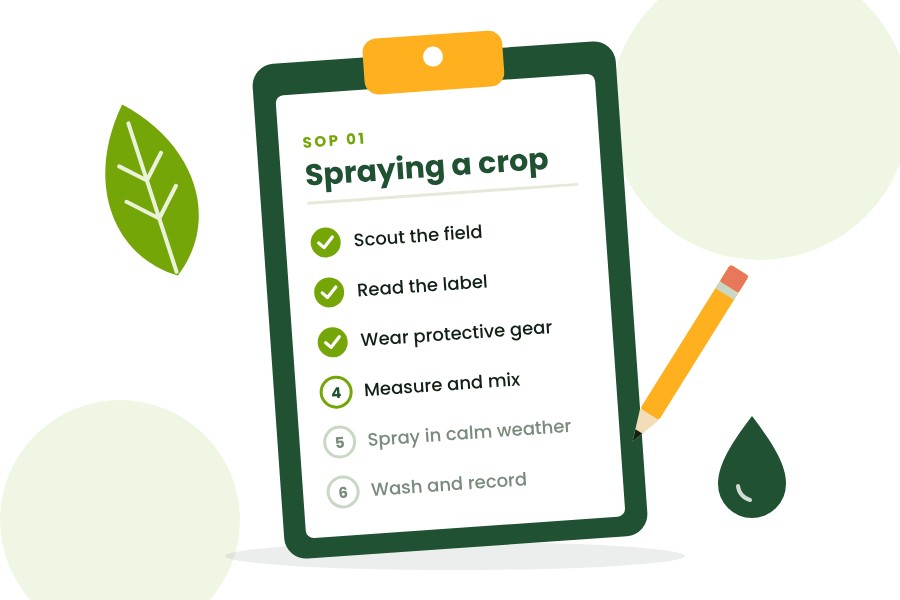
- 1Scout the field, and confirm the pest and the need to spray.
- 2Read the product label for the rate, the crop and the waiting period before harvest.
- 3Put on gloves, mask, overalls and boots.
- 4Measure the product with a jug, and mix it in the sprayer as the label directs.
- 5Spray in calm, cool weather. Keep other people and animals out of the field.
- 6Wash the sprayer and yourself. Store the product locked away.
- 7Mark the field with the earliest safe harvest date.
Milking a cow by hand
Purpose: to produce clean milk, and catch udder infection early.
- 1Wash your hands with soap, and dry them.
- 2Wash the udder with clean water, and dry it with a clean cloth.
- 3Draw the first milk from each teat into a strip cup. Check for clots or blood.
- 4Milk a cow with abnormal milk last, and keep her milk apart.
- 5Milk fully and quickly into a clean metal bucket.
- 6Dip each teat in teat dip.
- 7Sieve the milk, cover it and deliver or cool it at once.
- 8Wash all equipment, and leave it to dry upside down in the sun.
Receiving day-old chicks
Purpose: to settle chicks quickly, and catch a bad batch on day one.
- 1Clean and disinfect the brooder, and lay fresh litter, before the chicks are ordered.
- 2Light the heat source ahead of arrival, as the hatchery advises.
- 3Count the chicks on arrival, against the delivery note.
- 4Check for weak, wet or dead chicks, and note the number.
- 5Give clean water first, then chick feed.
- 6Watch how the chicks spread. Huddling means cold. Crowding the edges means hot.
- 7Report any shortfall to the hatchery the same day.
Harvesting, grading and lot coding
Purpose: to keep quality, and trace every bag to its field.
- 1Check the spray record. Do not harvest before the safe date.
- 2Harvest in the cool of the day, into clean crates.
- 3Move produce to shade within the hour.
- 4Sort out damaged or diseased produce.
- 5Grade by size, as your buyer specifies.
- 6Weigh each crate or bag.
- 7Write the lot code on it: the field and the date.
Letting a visitor onto a livestock unit
Purpose: to keep disease out.
- 1Stop every visitor and vehicle at the gate.
- 2Ask which farms they have visited that day.
- 3Refuse entry to the animal area if they came from a farm with sick stock.
- 4Give farm boots and overalls.
- 5Have them step through the foot dip.
- 6Escort them. Keep them away from feed and water.
- 7Collect the boots and overalls for washing when they leave.
Buying inputs and paying suppliers
Purpose: to pay a fair price, once, for what was really delivered.
- 1Write what is needed, how much and by when.
- 2Get three quotes for any large purchase.
- 3Place a written order with the chosen supplier.
- 4Check the delivery against the order. Count it, and check dates and seals.
- 5Match three papers before paying: the order, the delivery note and the invoice.
- 6Pay by bank or M-Pesa, not cash. Ask for an eTIMS receipt.
- 7Enter the purchase and the stock the same day.
Each one ends in a record. The formats are in our farm record keeping examples.
Process map and organisation chart: draw the job first
A process map is a drawing of a job from start to finish. Draw it first, and the SOP steps almost write themselves.
Here is a sample flow chart for one process: from ordering inputs to paying for them.
- 1Step 1RequestSupervisor lists what is needed.
- 2Step 2QuoteClerk collects three quotes.
- 3Step 3OrderManager approves and orders.
- 4Step 4ReceiveStores check the delivery.
- 5Step 5Pay and recordClerk matches papers, pays, records.
Each step names who does it. Where a job changes hands, mistakes happen. Those hand-overs need the clearest instructions.
The organisation chart
An SOP must name a role, not a person. The chart shows who reports to whom, and who checks the work.
Draw both on paper first. A flow chart in Word or Google Docs is enough for the final copy.
SOP writing and operations manuals for farms and agribusinesses
Agcenture maps your processes, writes your procedures with your team and trains your staff. You get a manual an auditor, a lender or a new manager can use.
Talk to AgcentureRoot cause analysis: what to do when an SOP fails
Ask “why” five times. Root cause analysis finds the reason behind a failure, so you fix the method, not blame the worker.
| Ask | Answer in this illustration |
|---|---|
| The problem | The cooperative rejected the morning milk. |
| Why? | It failed the freshness test. |
| Why? | It reached the cooler three hours after milking. |
| Why? | The milker waited for the evening milk can to be returned. |
| Why? | The farm owns one can. |
| Why? | Nobody had written down how fast milk must be delivered. |
The root cause is a missing step and a missing can, not a lazy milker. The fix: buy a second can, and add a delivery time to the SOP.
For a bigger problem, sort the possible causes under five headings: people, method, materials, equipment and environment. That is the fishbone method.
Record each failure and its fix. A complaint from a buyer deserves the same treatment, and a reply.
From SOPs to an operations manual
An operations manual is the file that holds your SOPs, policies and forms. It is what a new manager reads in the first week.
| Section | What goes in it |
|---|---|
| 1. The farm | Enterprises, map of blocks or units, organisation chart |
| 2. Policies | Safety, visitors, credit sales, cash handling, complaints |
| 3. SOPs | One page per job, numbered |
| 4. Forms and records | A blank copy of every record the SOPs name |
| 5. Contacts | Vet, agronomist, buyers, suppliers, emergency numbers |
| 6. Document control | A list of every document, its version, date and owner |
Document control sounds grand, and is one page. It stops two versions of the same SOP being used at once.
The strategy and the money side sit elsewhere. See our farm business plan guide and how to make a farm budget.
How to write an SOP in 5 steps
Write it with the person who does the job. An SOP written in the office describes a job nobody does.
- 1Step 1Watch the jobStand beside your best worker. Note each action.
- 2Step 2Write the stepsOne action per line, in the worker’s own words.
- 3Step 3Test itGive the page to someone new. Fix whatever confuses them.
- 4Step 4Post and trainPin it where the job is done. Walk every worker through it.
- 5Step 5ReviewCheck it yearly, and after every failure.
Use Kiswahili or the local language if that is what your workers read. Add a photo or a sketch for any step that is hard to describe.
Software can enforce a procedure, not only describe it. Agriware, from our sister company Lightswitch, refuses a spray that breaks the harvest interval. See farm management software in Kenya.
Need office procedures, such as bank reconciliation? Our sister site Trailblazers covers bookkeeping for small businesses in Kenya.
If the job lives in one person’s head, the farm stops when that person does.
Procedures need records to prove them
Agcenture writes SOPs and operations manuals, and sets up the records that go with them.
Start with the records your procedures will name. Then talk to us.
Written by Agcenture Consulting
We advise farmers, agribusinesses and lenders on agricultural finance, farm planning and market systems across East Africa.
Questions readers ask
What does SOP stand for?
Standard operating procedure. It is a written, step-by-step method for one job.
What is the meaning of SOP in business?
The agreed way a task is done, written down. Any trained person can then do it the same way.
What is an example of a standard operating procedure?
A one-page spraying procedure: scout, read the label, wear protective gear, mix, spray, wash and record.
What is the difference between an SOP and a policy?
A policy states the rule. An SOP gives the steps that carry it out.
What is a process map?
A drawing of a job from start to finish, showing each step and who does it.
What is root cause analysis?
A method for finding why a failure happened, often by asking "why" five times.
What is an operations manual?
One file holding the policies, SOPs, forms, contacts and organisation chart of a business.
How long should an SOP be?
One page. If it runs longer, split the job into two procedures.