Is Kienyeji chicken farming profitable? The Kienyeji chicken are also known as the indigenous, traditional, country or organic chicken in English. In this post, we will give you estimated profits and costs of raising 100 kienyeji chicken in Kenya. Besides, we give you projections for rearing 200, 500 and 1000 improved chicken such as Kuroilers Kenya.
- Facts about improved kienyeji chicken farming
- Why kienyeji chicken farming
- How to estimate profits and costs in Kienyeji chicken farming
- Cost of rearing 100 Kienyeji chicken in Kenya
- Costs and profit for 200 improved KARI Kienyeji chicken in Kenya
- Profit and cost of rearing 500 Kienyeji chicken in Kenya
- How profitable is Kenbro farming-1,000 birds
- How to succeed in Improved Kienyeji farming?
Facts about improved kienyeji chicken farming
The Kienyeji chicken farming sector is a priority value chain in 29 counties in Kenya. It receives major attention by farmers, investors and other players. Here are the key facts to remember about Kienyeji chicken in Kenya.
- The best improved kienyeji chicken breeds in Kenya include;
- Kuroilers
- Kenbro
- Sasso
- Rainbow roosters
- The Kienyeji chicken mature in a short period of 4-5 months.
- The Improved indigenous chicken have higher meat and egg yields. A mature rooster can weigh up to 3 kg live weight, while mature hens weigh 1.9-2.5 kg.
- The price of a mature Improved kienyeji chicken is KES 800 and KES 600 per rooster and hen, respectively.
- The traditional chicken eggs are brown and nutritious and while their meat is deep red with yellow fat.
Why kienyeji chicken farming
There are many benefits you can enjoy as a Successful Kienyeji chicken farmer compared to hybrid broilers and layers chicken farmers. They include You can earn more revenue and profits by marketing kienyeji chicken meat and eggs at a higher retail prices compared to other exotic products.
- The cost of farming indigenous chicken is lower since they are resistant to common disease chicken disease outbreaks in Kenya.
- There is a rising demand for high quality white meat and organic eggs since Consumers believe the traditional breeds have higher nutrition and better taste than hybrid broilers and layers.
How to estimate profits and costs in Kienyeji chicken farming
How much money exactly will you make (profits) and spend (cost) by rearing the kienyeji chicken for profits in Kenya? To estimate, we will make the following assumptions to gauge the amounts and prices for chicken feed, vaccines and other inputs.
- The farmer’s chicken stock comprise of 50% roosters and 50% hens
- There is an estimated 10% loss of cockerels, hens and eggs during the production season.
- The selling prices for your chicken farm yields and by-products are;
- Ksh 800 for a mature Kienyeji rooster and Ksh 600 for mature ex layer hens.
- Ksh 450 for a tray of Kienyeji eggs (Ksh 15/egg)
- Ksh 30 for every bag of chicken manure.
- Ksh 20 for used chicken feed bags
- Labor requirements is 1person at 4,000 monthly for 21 months.
- The Kienyeji chicken needs to be vaccinated for the following chicken diseases to minimize risks.
- Marek,
- Newcastle,
- Gumboro,
- Fowl Typhoid
- Fowl Pox diseases.
- The cost of buying a one-day-old kienyeji chick is Ksh 100
- The Kienyeji chicken feeding can follow the following recommended feed amount per chick each day.
- 60g/chick of chick mash chicks each day from week 1-8.
- 90g/chicken of growers mash per day from week 9-19
- 120g/hen per day from week 20-84
Cost of rearing 100 Kienyeji chicken in Kenya
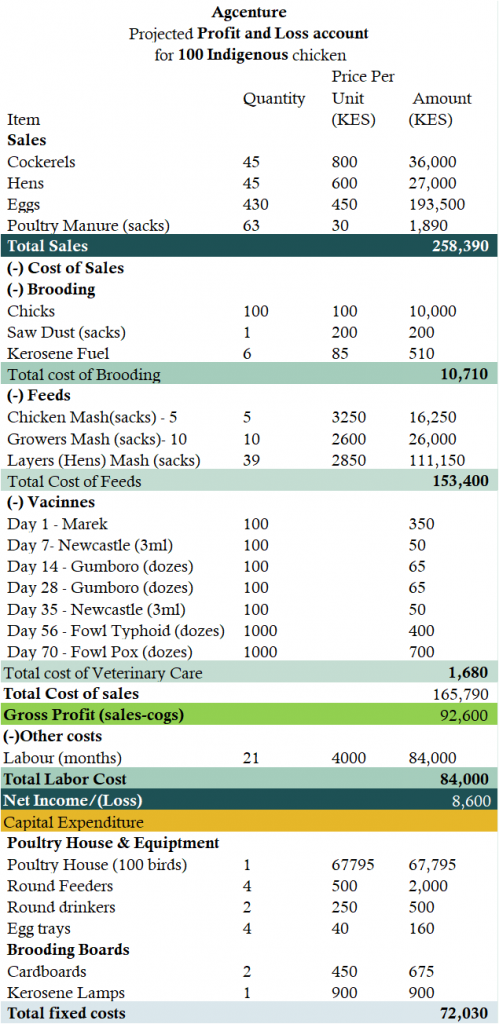
The following is the expected profits and cost of raising 100 traditional chicken in Kenya. The estimates use the current market prices and the standard feed requirements.
You will make a revenue of Ksh. 258,890 by rearing 100 improved kienyeji chicken in Kenya. These sales are for your mature roosters, ex layer hens, eggs and chicken manure as shown in the figure above. Our estimate assumed a 10% loss of the birds and eggs. You can reduce these losses to make more profits by;
- observing proper feeding of your birds.
- Good hygiene and biosecurity measures in your farm like and vaccination and disinfecting your poultry houses.
- Market all the by-products like empty chicken bags and chicken manure.
- Consider value addition to earn make more sales revenue in the long run.
On the other hand, the cost of rearing 100 Kienyeji chicken in Kenya is Ksh 165,790. This analysis ignores the capital expenditure and focusses on cost of chicken production. As shown above, 92 per cent of the cost is used to for buy chicken feed.
The profits of rearing 100 Kienyeji chicken in Kenya is Ksh 92,600. These amounts on the lower side are after a further deducting of Ksh 84,000 additional cost of labour, you will get a net profit of Ksh 8,600.
If you are a beginner in poultry keeping, then you will incur an initial capital investment of Ksh 72,030. These are needed for a new kuku kienyeji chicken house, brooding equipment, and other reusable items like feeders. Luckily, you can lower the CAPEX expenditure by leasing chicken houses.
Costs and profit for 200 improved KARI Kienyeji chicken in Kenya
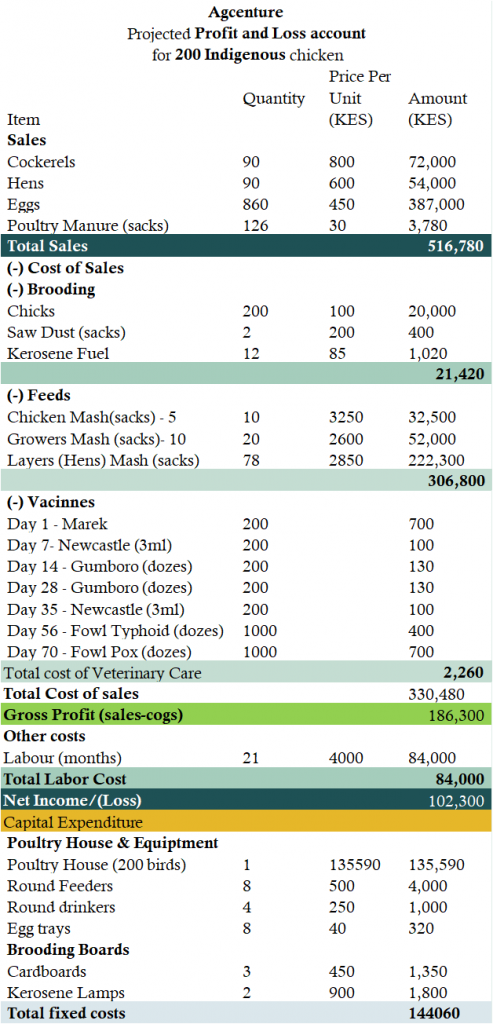
The following is a cost-benefit/ Gross margin analysis (CBA) for rearing 200 Improved KARI Kienyeji chicken for meat and eggs in Kenya. It uses the current market prices and the above-given assumptions.
The revenue of selling mature live birds (mature cockerels and hens), poultry manure and eggs is Ksh 516,780. The bulk of it is after selling eggs as the primary product. You can increase your profits by incubating the eggs and selling vaccinated one-day-old chicks. You would increase the price of one egg from Ksh 15 to Ksh 100.
The larger portion of the operating is buying chicken feed at Ksh 306,800. The total operating cost of the project is Ksh 330,480 to get a gross profit of Ksh 186,300. After considering the cost of monthly labour of Ksh 4000 for 21 months, you will pocket Ksh. 102,300 net profit.
As a beginner, you will incur a one-time capital expenditure of Ksh 144,060 to make a kienyeji chicken house
Profit and cost of rearing 500 Kienyeji chicken in Kenya
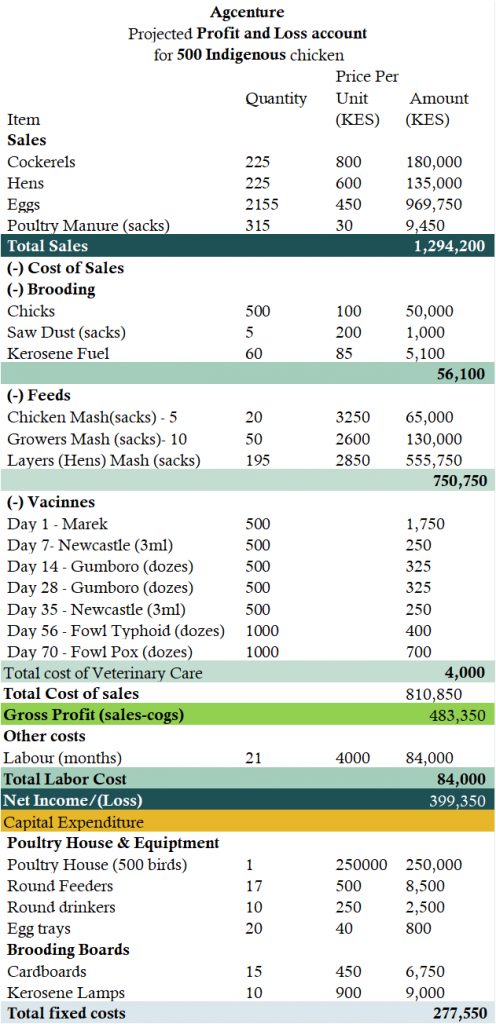
The following is a projection of revenues and costs of rearing 500 Improved KARI Kienyeji chicken like Kuroilers in Kenya. The analysis uses the current market prices and the above assumptions for feed quantities and vaccines.
The gross sales revenue for 500 indigenous chicken farm is Ksh1, 294,200. The most significant sales are from selling eggs.
The operating costs for raising 500 chicken is Ksh 810,850. It will give you a gross profit of Ksh 483,350 and a net profit of Ksh 399,350 after deducting labour costs of Ksh 84,000.
As a startup venture, you need a capital expenditure of Ksh 277,550 for a fully functional 500 chicken house. The overall costs and profits for keeping 500 indigenous chickens are as shown above.
How profitable is Kenbro farming-1,000 birds
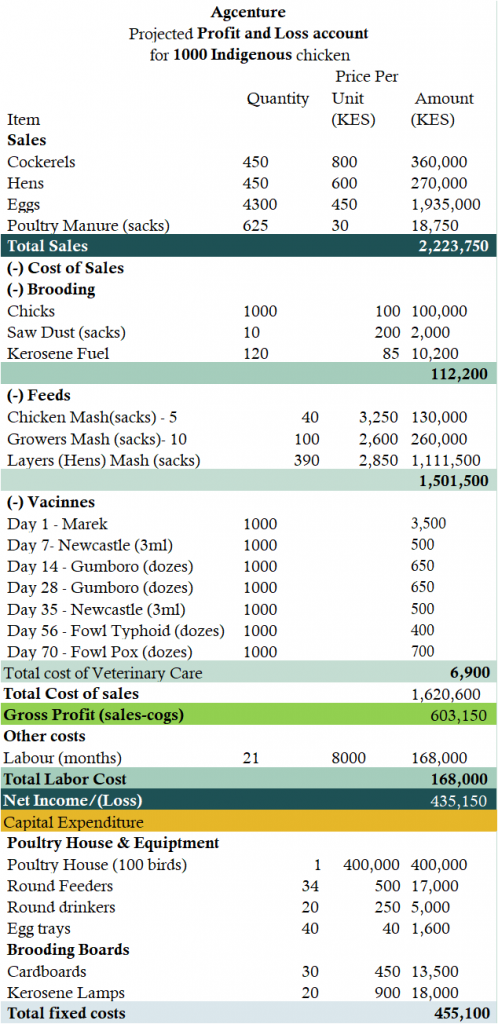
The following is a gross margin analysis for rearing 1,000 improved KARI kienyeji chickens like the improved KALRO kienyeji chicken or Kenbro. It uses the current market cost, prices, and the above assumptions required for farm inputs and labour.
You will get a total revenue of Ksh 2, 223,750 after marketing your live birds, eggs and poultry manure.
The operating cost for your 1000 chicken farm is Ksh 1,620,600 excluding the one-time capital expenditure of Ksh 455,100 for beginners. The most significant expense is buying commercial chicken feed at a value of Ksh 1,501,500.
The projects’ gross revenue is Ksh 603,150. The only additional cost is labour at Ksh 168,000 getting you a net profit of Ksh 435,150. The overall benefits for keeping 1000 layers are as shown above.
The gross and net profits of raising indigenous chicken assume the worst-case scenario. The conventional and best-cases will give you a higher income.
How to succeed in Improved Kienyeji farming?
Looking for the best tips to make more money in improved indigenous chicken farming? watch the YouTube Video below on the best tips to maximise profits. Thet include tips such as;
- Formulating your own chicken feed at home using cheaply available sources like maize, wheat, and sunflower seeds etc.
- Raising the improved breeds like the Improved KARI Kienyeji, kenbro or Kuroilers. They grow faster, give you more yields andyou can sell them att higher prices.
The Video below has more.
Did you Like the Post? Let us know below
Agcenture.com is your best agriculture, food & health blog.
Thank you for following us on Facebook, Twitter (X), LinkedIn, YouTube, and WhatsApp @ Agcenture for the latest updates.





I was very happy to read this report. However, its summarized information, it has reference to all necessary capital costs, operational cost, feed costs and labor costs to help one figure out gross margin and net profits, for different number of birds, say 100, 200, 500 and 1,000.