Key takeaways
- Records move onto Ardhisasa registry by registry, not county by county.
- Stamp duty has run through ArdhiPay since 16 February 2026.
- Duty is assessed on a government valuation, not on your purchase price.
- A clean search confirms the register only, never the land itself.
Register early, confirm your registry is live, run the search yourself, and budget duty from the valuation.
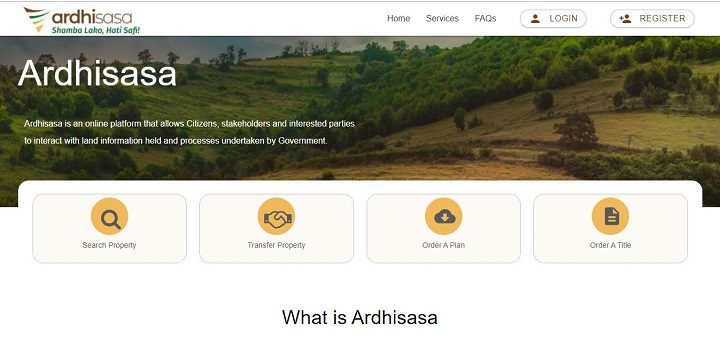
Ardhisasa is the national land information management system. It handles searches, transfers, consents, subdivisions and payments online.
For a buyer, it changes where the work happens. It does not change the checks you still owe yourself.
This article covers what the platform now does and which registries are live. It ends with what Ardhisasa cannot protect you from.
What Ardhisasa is now
It started as a Nairobi pilot in March 2021. Treat anything written then as out of date.
The platform is run by the Ministry of Lands and Physical Planning with the National Land Commission. It carries land registration, land administration, physical planning, survey and mapping, valuation, and adjudication services.
The practical change is that transactions on an onboarded registry are processed on the platform only. Manual processing for those records stops.
On an onboarded registry, there is no counter to fall back on.
The rollout is by registry, not by county
This is the detail most guides get wrong, and it decides whether you can transact at all.
Records move onto Ardhisasa registration section by registration section. A county can be partly live and partly manual at the same time.
The State Department for Lands has published this as it goes. Mombasa Block XVI and Block XVII went live on 21 July 2025. Further Mombasa blocks followed on 20 July 2026. Murang’a, Isiolo and Mombasa Island have also been rolled out.
Before you commit to a timeline, establish whether your specific parcel sits on an onboarded registry. Your advocate can confirm this in a few minutes.
Register before you need it
Registration is slower than it looks, because it verifies you against government records.
The system accepts individual landowners, professionals such as advocates and surveyors, and companies. You will need your national ID number, your KRA PIN, a phone number and an email address. Verification runs by one-time password.
- 1Create the account at ardhisasa.lands.go.ke using your ID or registration number.
- 2Verify the phone number and email with the one-time password sent to each.
- 3Match your details to your records, because an ID or KRA PIN mismatch stalls everything later.
- 4Scan every land document you hold before you start a transaction.
- 5Claim your parcels on the platform if you already own land on an onboarded registry.
Do this well before a deal. A seller without a verified profile cannot complete a transfer to you.
Running a search before you pay
The official search is still the single most valuable thing you will do.
It confirms the registered owner, the tenure, the size, and any charges, cautions or restrictions on the parcel. Run it in your own name. Never accept a search certificate produced by the seller.
The fee is set by the Ministry and paid inside the platform. Published figures differ between guides, so take the current amount from the portal rather than from an article.
A search is not always instant. Allow a few working days, and build that into your offer timeline.
Stamp duty now runs through ArdhiPay
This is the change that affects every buyer, on every parcel.
Stamp duty services moved to the ArdhiPay land stamp duty module. Physical submissions at land registries stopped on 16 February 2026. The whole sequence now runs online, from application through valuation to payment.
Duty is assessed on a government valuation, not on your purchase price. The valuer’s figure can exceed what you paid.
The rate is 4 per cent of the assessed value inside gazetted municipalities. Outside them it is 2 per cent. A 2024 Ministry directive moved more than 83 areas into the municipal band. Kitengela, Kajiado, Nakuru and Kiambu are among them.
Budget the duty from the valuation, not from the price you negotiated.
What Ardhisasa does not remove
The platform digitises the process. It does not do your due diligence.
| Still required | Why it matters |
|---|---|
| Physical inspection | Boundaries, access and drainage do not appear in any record |
| Land Control Board consent | Agricultural land in a land control area cannot transfer without it |
| Your own advocate | Offer letters, sale agreements and transfer documents still need drafting |
| A surveyor | Beacons on the ground can differ from the map |
| Neighbour and history checks | Previous use and disputes sit outside the register |
A clean search tells you the register is clean. It tells you nothing about the soil, the road or the neighbours.
Where it still goes wrong
Four failures account for most delays.
A mismatch between your ID or KRA PIN and government records stops verification. One wrong digit in a title or LR number returns a different parcel entirely. A seller with no verified profile cannot act on their side. And a parcel on a registry that has not been onboarded cannot be transacted online at all.
None of these are fatal. All of them are cheaper to find in week one than in week six.
The point: a better process, not a shorter checklist
Ardhisasa removes queues, middlemen and most of the paperwork. That is a real gain.
It does not remove the search, the inspection, the consent or the advocate. Those are what protect your money.
Register early, confirm your registry is live, run the search yourself, and budget duty from the valuation.
Sources: State Department for Lands. Ardhisasa portal. Reporting on the stamp duty move, February 2026. Fees, bands and rollout status current at November 2026. Confirm each with the portal before you transact.
Buying a parcel this season?
The register is one check of several. Most buyers stop there.
Agcenture Consulting advises farmers, agribusinesses and lenders on agricultural finance, farm economics and market access across Kenya.
If you are assessing land, talk to Agcenture.
Written by Agcenture Consulting
We advise farmers, agribusinesses and lenders on agricultural finance, farm economics and market access across Kenya. Our guides use public sources and clearly labelled assumptions.
Questions readers ask
Is Ardhisasa available in all counties?
No. Records move on registry by registry, so a county can be partly live and partly manual. Confirm the status of your specific parcel.
Can I still pay stamp duty at a land registry?
No. Physical submissions stopped on 16 February 2026, and the process now runs through the ArdhiPay module.
What do I need to register?
A national ID or registration number, a KRA PIN, a phone number and an email address. Verification is by one-time password.
Does a clean search mean the land is safe to buy?
No. It confirms the register only. Boundaries, access, soil and previous use still need checking on the ground.
Do I still need Land Control Board consent?
Yes, for agricultural land in a land control area. The platform does not remove that requirement.
Why has my transaction stalled?
Usually an ID or KRA PIN mismatch, or a mistyped parcel number. Sometimes a seller without a verified profile.