In this article
Key takeaways
- Only 16% of Kenya's farm produce is processed at home, says Invest Kenya.
- Between 30 and 40% of Kenyan food is lost before it reaches a consumer.
- Imports meet 90 to 95% of edible oil demand, yet oil factories lack raw material.
- A KSh 40,000 solar dryer must sell about 4.2 kg a day to cover its costs.
- Budget KSh 68,000 to KSh 88,000 for that unit, with permits and one month of stock.
- Agro-based manufacturing shrank 1.2% in 2025, so line up a buyer before you buy equipment.
Agro-processing makes up more than 40% of Kenya’s manufacturing output. Yet only 16% of farm produce is processed at home (Invest Kenya, March 2026). Both figures are true. The gap between them is your opportunity.
The situation that eats your margin is post-harvest loss. Between 30 and 40% of Kenyan food never reaches a consumer. That costs about KSh 72 billion a year (Food Business Africa, citing WRI Africa).
This guide gives you three things. You see where demand outruns supply. You see what a small unit costs, using listed prices and a worked budget. You see the rules to clear before you sell.
Processing pays when it turns a perishable crop into a product you can store and sell.
Is agro-processing profitable in Kenya? It can be. Pick a crop that is lost or imported. Sign a buyer first. Keep your margin a kilo above your running costs. In our example, a KSh 68,000 cassava drying unit earns about KSh 9,100 a month. It pays back in about 7 months. That is a model on stated assumptions, not a forecast.
Is it profitable? Where is demand? Which ideas? What does it cost? Which permits? Who buys?
Is Agro-Processing Profitable in Kenya? The Numbers Behind the Hype
The sector is large. Invest Kenya says agro-processing gives about 9.5% of GDP and more than 40% of manufacturing output. It counts about 407 registered food processing firms across 13 subsectors (July 2025). It does not state the year for the GDP and output shares.

The same agency reports average returns of 16 to 22%. It gives payback of three to five years for most projects. Treat those figures with care. They come from an investment promotion agency, and they describe investor-scale plants. A micro unit pays back faster or never, depending on your margin a kilo.
The sector is not a sure bet. Agro-based manufacturing shrank 1.2% in 2025. It had grown 7.9% in 2024 (The Standard, on the Economic Survey 2026). Sugar output fell 24.8%. Processed milk grew from 619.1 to 701.5 million litres. Meat processing grew 9.8%. Winners and losers differ by product, so choose your product before your machine.
Where Demand Outruns Supply: Seven Gaps You Can Fill
Start with what buyers already lack. Each row below shows a gap that processing can close.

Seven gaps between what Kenya grows and what it processes
| Product | The gap | Source | Business it suggests |
|---|---|---|---|
| Fruit | Mangoes lose 17 to 56% after harvest. Domestic channels lose 35%, against 15% in export channels. | Food Business Africa, 28 May 2026 | Drying, pulping, juice |
| Maize and flour | Maize loses 20 to 36%. A 90 kg bag rose from KSh 3,800 to 4,200 in weeks. Unga hit KSh 170 for 2 kg in some stores. | The Star, 4 Sep 2025; Mwakilishi, 13 Feb 2026 | Milling, storage, fortified flour |
| Potatoes and cassava | Potatoes lose 19 to 23% by weight, plus 9% in quality. Fresh cassava sells for KSh 10 a kilo in a glut. Processed, it sells for KSh 40 to 90. | The Star, 4 Sep 2025; The Star, 28 Jul 2026 | Chips, crisps, flour |
| Edible oil | Imports meet 90 to 95% of demand. The import bill passed KSh 145 billion in 2022. Local factories run below capacity for lack of seed. | The Star, 14 Mar 2026 | Sunflower pressing, contract growers |
| Milk | Only 40% of milk is value added. The target is 60%. Processed milk grew from 619.1 to 701.5 million litres in 2025. | Capital FM; The Standard, 1 May 2026 | Cooling, yoghurt, ghee |
| Fish | Kenya has a supply gap of 450,000 tonnes a year. Production was 168,000 tonnes in 2024. Fish lose 34% after landing. | Food Business Africa, 1 Apr 2026; The Star | Drying, smoking, cold storage |
| Meat | Meat processing grew 9.8% in 2025. Invest Kenya targets meat exports of US$130.5 million by 2028, up from US$102 million. | The Standard; Invest Kenya | Cutting, packing, drying |
Figures come from the sources shown and keep their own years. Loss rates vary by handling, county and season.
Read these rows as signals, not guarantees. Edible oil shows why. Imports meet 90 to 95% of demand. Yet factories run underused because raw material is short (The Star). The shortage sits on the farm, not in the factory.
So your first question is raw material. Who grows it, when, and at what price? Your second is the buyer. Who pays you, and how soon?
12 Agro-Processing Business Ideas to Start in Kenya, From Home Scale to Factory Scale
Pick one idea that matches a gap above. Then start with the smallest machine that serves your first ten customers. Prices are listed asking prices, checked on 9 and 10 November 2026 for our machines guide. They are not supplier quotes.

12 agro-processing ideas, who buys, and the first machine
| Idea | What you sell | Who buys | First machine and listed price |
|---|---|---|---|
| Dried fruit and cassava chips | Dried mango, banana, cassava chips | Shops, distributors, supermarkets | Solar dryer from KSh 40,000 (The Star). Commercial dehydrator KSh 31,500 to 60,000 (Jumia) |
| Cassava and potato flour | Flour and crisps | Bakeries, shops, households | Small electric mill KSh 11,399 to 15,120 (Jumia) |
| Spice and herb powders | Ground and blended spices | Shops, caterers, households | 1 kg grinder KSh 13,630 (Jumia). Heat sealer KSh 3,500 (Formulators Hub) |
| Peanut butter | Packed spreads | Shops, schools, households | Machine KSh 4,390 to 9,500 (Jumia, 10 Nov 2026) |
| Fruit juice and pulp | Bottled juice and pulp | Cafes, shops, hotels, events | Commercial extractor about KSh 41,300 to 42,800 (Jumia). Pasteuriser: get quotes |
| Flour milling | Maize, sorghum and millet flour | Households, shops, institutions | Small mill as above. A posho mill needs quotes |
| Baked goods and biscuits | Cakes, biscuits, vitumbua | Households, shops, cafes | Makers list at KSh 1,699 to 5,999 (Jumia) |
| Sunflower oil pressing | Cooking oil and seed cake | Households, shops, feed mixers | No reliable Kenyan price found. Get quotes |
| Milk cooling, yoghurt and ghee | Chilled milk, yoghurt, ghee | Dairy groups, shops, households | Solar cooler: see our milk cooler guide |
| Fish drying and smoking | Dried and smoked fish | Markets, hotels, shops | No reliable Kenyan price found. Get quotes |
| Animal feed pellets | Pelleted feed | Farmers and feed shops | Pellet machines of 100 to 450 kg an hour on Jiji, price not shown |
| Packing and branding | Sealed, labelled pouches | Any idea above | Heat sealer KSh 3,500 (Formulators Hub) |
We found no reliable Kenyan price for oil presses, fish smokers or pasteurisers. Confirm delivery, accessories and warranty before you pay.
Go deeper on the crop you choose. Our guide to the root crop processing guide covers roots. Read vegetable processing methods for greens and tomatoes. Read the maize milling business guide for flour. Our animal feed business guide covers the pellet idea.
Non-food chains add value too. Hides, skins and timber need more capital and longer lead times. See commercial tree farming in Kenya if timber is your route.
How Much Does It Cost to Start an Agro-Processing Business? A Worked Example With Real Prices
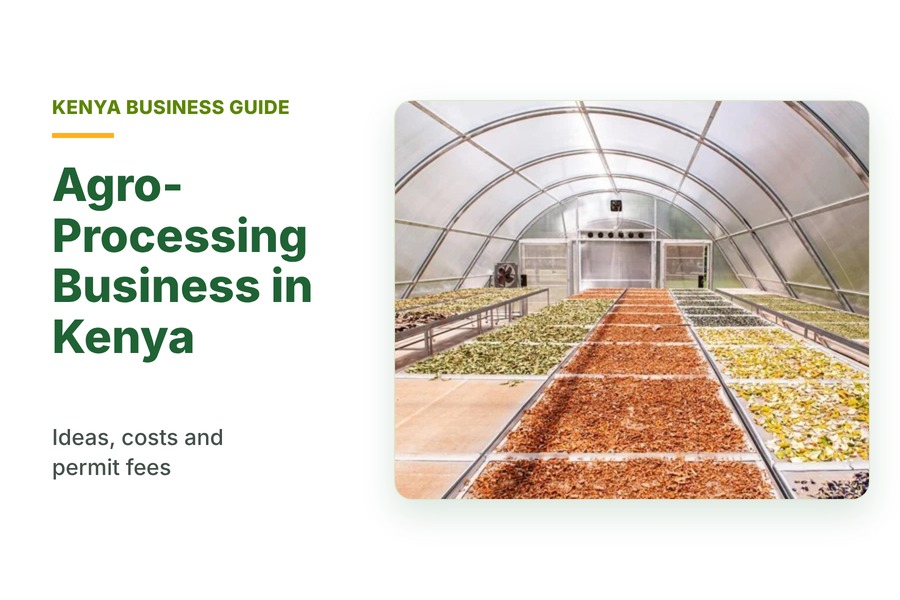
We model the smallest honest case: a solar drying unit that dries cassava. The machine price is real. The cassava prices come from The Star. The volumes and running costs are our assumptions. Replace them with your own quotes.

Start-up budget for a small cassava drying unit
| Item | Cost | Source or assumption |
|---|---|---|
| Solar dryer, entry system | KSh 40,000 | The Star, 28 Jul 2026 |
| One month of materials | KSh 10,800 | Assumption: 15 kg x 24 days x KSh 30 |
| Business name search and registration | KSh 1,200 | BRS fee schedule: KSh 250 and KSh 950 |
| County permit | KSh 5,000 to KSh 25,000 | Nairobi bands, 15 Sep 2026 |
| Food handler certificate | KSh 1,000 | PayBill KE |
| KEBS S-mark inspection | KSh 10,000 | KEBS FAQ: a site, up to three products, two years |
| Total start-up | KSh 68,000 to KSh 88,000 | The range comes from the permit band |
Totals use the lowest and highest county permit band. A workshop may sit in a different band, so confirm with your county.
Now the monthly picture. Dry 15 kg a day for 24 working days. At KSh 65 a kilo, gross sales are KSh 23,400. Materials cost KSh 10,800. Other costs and repairs take KSh 3,500. You keep KSh 9,100 a month before income tax and your own pay.
Your break-even is about 4.2 kg a day. Payback on the full start-up cost is 7.5 to 9.7 months. Yearly gross sales of KSh 280,800 sit below KSh 1 million, so no turnover tax applies.
Monthly surplus at different prices and daily volumes
| Selling price | 10 kg a day | 15 kg a day | 20 kg a day |
|---|---|---|---|
| KSh 40 a kilo | -KSh 1,100 | KSh 100 | KSh 1,300 |
| KSh 65 a kilo | KSh 4,900 | KSh 9,100 | KSh 13,300 |
| KSh 90 a kilo | KSh 10,900 | KSh 18,100 | KSh 25,300 |
Surplus before income tax and your own pay. Materials KSh 30 a kilo, other costs and repairs KSh 3,500 a month.
The table carries one warning. At KSh 40 a kilo, the unit barely covers its costs at 15 kg a day. At 10 kg a day it loses money. Price decides the outcome more than volume does. Test your selling price with five buyers before you buy the dryer.
Larger units need quotes. We found no reliable Kenyan price list for a pasteuriser, oil press or milk plant. Invest Kenya reports returns of 16 to 22% on investor-scale projects. It gives no equipment prices. Get three written quotes for any plant above KSh 1,000,000.
Test your own processing numbers
Send us your product, raw material source and buyer. We will build your break-even and cash plan.
Contact AgcentureLicences, Standards and Fees: What to Clear Before You Sell
Rules depend on what you make and where you sell. Food you process and pack for sale brings health and standards rules. Use this table as a checklist.
Fees and approvals for a small processing unit
| Requirement | Cost | Notes and source |
|---|---|---|
| Business name | KSh 250 search, KSh 950 registration | BRS. A private limited company costs KSh 10,650 |
| County permit | KSh 5,000 to 25,000 a year in Nairobi | BusinessPlans.co.ke, 15 Sep 2026. It names retail bands, not workshops |
| Food handler certificate | KSh 1,000 | PayBill KE |
| KEBS Standardization Mark | KSh 10,000 a site for up to three products | KEBS calls it mandatory for locally made products. Extra products cost KSh 10,000 each (FAQ) |
| Fortification logo | KSh 20,000 a product | Wheat flour, maize flour and edible oil only. It needs an S-mark first (KEBS FAQ) |
| Turnover tax | 1.5% of monthly sales | Yearly sales of KSh 1 million to 25 million (Zoho Books) |
Fees change. Confirm each one with the issuing office before you pay. Pay the county only against an invoice from its portal.
Larger investors have extra options. Invest Kenya lists a 10-year corporate tax holiday in export processing and special economic zones. It also lists import duty exemption on machinery and raw materials there. It lists a 100% investment deduction on new plant and machinery for agro-industrial investors. Check the current Finance Act before you plan around any of them.
Who Buys Processed Food in Kenya? Supermarkets, Schools, Hotels and Exporters
Sell to people who already buy the product. Shops, schools, hotels, caterers and supermarkets buy packed food in batches. Show samples, take orders by WhatsApp and ask for a deposit. Keep the first order small enough to deliver on time.
Export markets are opening. Invest Kenya says 23% of processed food exports went to African markets, up from 17% in 2020. Start at home. When quality is steady, read our guide to starting an agro export business.
Sell on quality, not on price alone. A sealed, labelled pouch looks more professional on a shelf. Our food business guide shows how buyers judge packed food.
How to Secure Raw Material: Contract Growers, Aggregation and Storage
Raw material decides whether your unit runs or idles. Maize rose from KSh 3,800 to 4,200 a bag within weeks in early 2026 (Mwakilishi, 13 February). A processor who buys on the spot market carries that swing.
- 1Contract growers. Agree volume, quality and price before planting. Our guide to contract farming in Kenya shows how.
- 2Group aggregation. Buy from farmer groups, not single farmers. You get volume and steadier quality.
- 3Storage. Store what you cannot process at once. Read our guide to preserving cereals and pulses.
- 4Cooling. Chill milk and other perishables at the source. See our guide to cheap milk coolers.
How to Fund a Processing Unit: Savings, Groups and Loans
Fund a micro unit from savings, a chama or a small group loan. A machine of KSh 40,000 does not need a bank. Larger units need institutional funding and a plan a lender can read. Start with our guides to agriculture finance in Kenya and government financing help.
Lenders want a buyer, a budget and a repayment plan. Write them into a farm business plan first. Then read how to make sure your farm loan is approved. Agcenture gives funding advice. We do not lend.
Keep two months of costs in cash before you start. A loan can buy a machine, but it cannot carry you through a slow month.
Five Risks That Close Processing Units
- 1No buyer. A machine earns nothing while it is idle. Sign your first buyer before you pay.
- 2Raw material swings. Prices and supply move with the season. Contract growers and storage reduce the swing.
- 3Thin margins. At KSh 40 a kilo, the drying unit above barely covers its costs. Test your price first.
- 4Skipped standards. A food product sold without the right approvals can be pulled from shelves. Ask KEBS first.
- 5A weak sector year. Agro-based output fell 1.2% in 2025. Do not borrow against growth that may not come.
How to Start an Agro-Processing Business in 6 Steps
- 1Choose one gap. Pick a crop that is lost or imported. Use the table of seven gaps.
- 2Line up raw material. Name your growers, volumes and prices before you buy equipment.
- 3Test five buyers. Ask what they pay now. Offer a sample and a deposit order.
- 4Get two quotes. Compare a Jumia listing with a local dealer. Ask about warranty and spare parts.
- 5Clear permits and standards. Register the name, get the county permit and ask KEBS about your product.
- 6Start small and track weekly. Record kilos, sales and costs. Scale only when the machine stays busy.
Processing pays when it turns a perishable crop into a product you can store and sell. Start with the gap, then the buyer, then the machine.
Questions Readers Ask About Agro-Processing in Kenya
What is agro-processing?
Agro-processing turns farm, forestry and fishing products into stable, higher-value goods. Examples are flour, dried fruit, cooking oil, yoghurt and smoked fish.
What is the difference between agro-processing and value addition?
Value addition is any step that raises a product's price. Processing is the most common step. Grading, packing and branding also add value.
Which agro-processing business is most profitable in Kenya?
It depends on raw material and buyers. Edible oil and fish show the widest supply gaps. Dried and packed foods need the least capital.
How much does it cost to start an agro-processing business in Kenya?
A small drying unit costs KSh 68,000 to KSh 88,000, with permits and one month of stock. Factory-scale units need written quotes.
Do you need KEBS approval to sell processed food?
KEBS calls the Standardization Mark mandatory for locally made products. Inspection costs KSh 10,000 a site. Ask KEBS about your product.
Can a small farmer start processing?
Yes. Start with a surplus crop you already grow. Fresh cassava sells for KSh 10 a kilo at peak. Processed, it sells for KSh 40 to 90.
Which crops can you process in Kenya?
Fruit, cassava, potatoes, maize, sunflower, milk and fish all show gaps in this guide. Choose the one you can source reliably.
Ready to plan your processing unit?
Tell us your product, raw material and buyer. A farm adviser replies within one working day.
Written by Agcenture
We help farmers and agribusinesses across Kenya plan farms, grow profitably and reach markets. Our guides use public sources and field experience.