In this article
Key takeaways
- A 90 kg sack of indigenous greens sells for KSh 3,500 to 5,000. Kale and cabbage fetch KSh 1,500 to 2,500.
- Kenya grows about 300,000 tonnes a year. Kunde, managu, terere and saga make up four-fifths of it.
- Most kienyeji greens give a first harvest in 3 to 5 weeks. You then pick every week or two.
- About 34% is lost between farm and plate. Drying and fixed buyers protect your income.
- Terere holds about 13 times the iron of cabbage. Saga holds over 100 times the beta-carotene.
Farmers once pulled terere out as a weed. In 2026 a 90 kg sack of kienyeji greens sells for KSh 3,500 to 5,000. A sack of kale or cabbage sells for KSh 1,500 to 2,500 (The Star).
Supply is the situation that decides your income. Demand is rising faster than farmers can pick. Yet Technoserve finds that 34% of these greens never reach a plate.
This guide gives you 20 kienyeji vegetable names in 10 languages. You get 2026 prices, growing steps for managu, terere and saga, and what an acre earns. You also learn where to sell fresh leaves and where dried leaves sell.
Fast harvests earn the money. Spoilage takes it back. Fixed buyers and drying keep it.
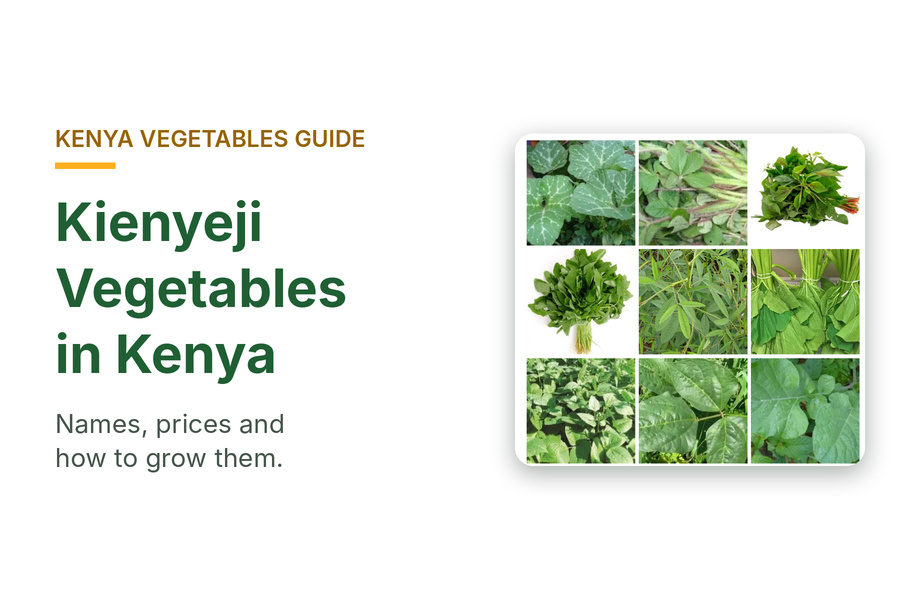
What are kienyeji greens? They are Kenya’s indigenous leafy greens, also called African leafy greens. The best known are terere, managu, saga and kunde. Mitoo and mrenda follow. In English they are amaranth, nightshade, spider plant, cowpea leaves, crotalaria and jute mallow. Kenya has about 210 species, and about 20 are eaten nationwide (Alliance Bioversity and CIAT).
What are the 20 vegetable names? Which is the most profitable vegetable? What are the health benefits of sagaa? Where can I buy dried vegetables? How do I grow them?
Kienyeji Vegetables in Kenya: 20 Names You Should Know, in 10 Languages
Every community has its favourite greens. Use the list below to match the name on a seed packet or a market stall.
- 1Terere. Amaranth, or mchicha. Purple, red or gold leaves.
- 2Kunde. Cowpea leaves. A legume that fixes nitrogen.
- 3Managu. African nightshade, or osuga. Leaves and berries.
- 4Saga. Spider plant, also sagaa or saget. A bitter leaf.
- 5Mitoo. Crotalaria. Popular in western Kenya.
- 6Mrenda. Jute mallow, or mlenda. Slimy when cooked alone.
- 7Misheveve. Pumpkin leaves, or malenge.
- 8Mabaki. Comfrey. A Kikuyu traditional vegetable.
- 9Thabai. Stinging nettle, Urtica massaica.
- 10Kanzira. Ethiopian mustard, or African kale.
- 11Moringa. A tree whose leaves are eaten.
- 12Mchunga. Launaea cornuta. A local wild green.
- 13Blackjack. A wild herb eaten in some communities.
- 14African eggplant. Leaves and fruit are eaten.
- 15Cassava leaves. Used by small-scale farmers.
- 16Sweet potato leaves. Used by small-scale farmers.
- 17Bean leaves. Used by small-scale farmers.
- 18Melon leaves. Used by small-scale farmers.
- 19Nderema. Malabar spinach. Common in coastal and rural Kenya.
- 20Kahurura. A vine vegetable like cucumber and watermelon.
Kienyeji vegetable names in English, botanical Latin and ten languages
| English and botanical name | Swahili | Kikuyu | Luo | Kisii | Kipsigis | Luganda | Kamba | Luhya | Other names |
|---|---|---|---|---|---|---|---|---|---|
| AmaranthAmaranthus dubius | Mchicha | Terere | Ododo | Emboga | Kelichot | Doodo | W'oa | Lidodo | Kichanya (Taita) |
| Cowpeas (leaves)Vigna unguiculata | Kunde | Mathoroko, Thoroko | Alot'bo | Egesare | Kundet | Kiyindiru | Nthooko, Nzooko | Likhuvi, Likhubi | Nthoroko (Embu), Tsafe (Giriama) |
| Black nightshadeSolanum nigrum complex | Mnavu | Managu | Osuga | Rinagu | Isoiyot | Nsugga | Kitulu | Namaska, Tsisutsa | Sochot (Keiyo), Ormomoi (Maa), Ndunda (Taita) |
| Spider plantCleome gynandra | Sagaa, Mwangani | Thageti | Alot Dek | Chinsaga | Saget | Jjobyu | Mwianzo | Tsisaka | Tsaga |
| CrotalariaCrotalaria ochroleuca | Marejea | Mitoo, Mito | Kipkururiet | Aubi | Kamusuusuu | Miroo, Kimiro, Emiro, Imito | Karma (Pokot) | ||
| Jute mallowCorchorus olitorius | Mlenda, Mulenda | Apoth | Omotere | Murere, Omurere, Mrere | Mrenda, Chikosho (Chonyi, Kambe), Vombo (Giriama) | ||||
| Pumpkin leavesCucurbita maxima | Malenge, Boga | Marenge, Kahurura | Budho | Risosa | Ensujja | Ulenge | Misheveve, Lisebebe | Kahurua, Kanyuria | |
| Stinging nettleUrtica massaica | Mpupu | Thabai, Hatha | Siwot | Kinyeleelya | Entamejoi (Maasai), Thaa (Meru), Mucururi (Mbeere), Kimeley (Marakwet) |
The last column lists names from other communities. Sources: Biovision Infonet for cowpea, crotalaria, jute mallow, pumpkin leaves and stinging nettle. Biovision factsheets cover amaranth, nightshade and spider plant.
The profiles below repeat these names beside each crop, with nutrition and uses.
Demand and Supply: Why Kienyeji Vegetables Sell Out Before 8 am
Kenyans grew about 300,000 tonnes of indigenous leafy greens in 2020. Output grew 4% a year from 2017 to 2020 (Technoserve). A BBC report says production has doubled in 10 years (UkrAgroConsult).
Sukuma wiki is still bigger. Farmers grew over 700,000 tonnes in 2023, more than double all indigenous leafy greens combined.
How much of each vegetable Kenya grows
| Vegetable | Tonnes a year | Share |
|---|---|---|
| Cowpea leaves (kunde) | 114,000 | 38% |
| African nightshade (managu) | 59,000 | 20% |
| Amaranth (terere) | 38,000 | 13% |
| Spider plant (saga) | 36,000 | 12% |
| Other species | 53,000 | 18% |
Tonnes are from Technoserve for 2020. Shares are our maths on the 300,000 tonne total.
Buyers are changing. Hospitals, schools and hotels now add kienyeji greens to their menus (The Star). A vendor at Wangige market in Kiambu says they are her most popular greens. A restaurant in Gachie charges extra for them because they are harder to source (BBC).
Supply has not kept pace. A trader at Lumakanda market says most of her stock sells by 8 am. Experts blame shrinking land, dry spells, fewer kitchen gardens and the spread of exotic crops.
Where kienyeji vegetables grow and what they earn (2020)
| Region | Tonnes | Hectares | Tonnes a ha | KSh a kilo |
|---|---|---|---|---|
| Western Kenya | 115,000 | 12,900 | 8.9 | KSh 35 |
| Central Kenya | 53,000 | 24,200 | 2.2 | KSh 19 |
| Coastal Kenya | 32,200 | 4,000 | 8.1 | KSh 25 |
Tonnes, hectares and production value are from Technoserve for the four main species. Tonnes a hectare (ha) is tonnes over hectares. KSh a kilo is farm-gate value over tonnes. Both are our maths.
Western Kenya gets 4 times the yield of Central Kenya from each hectare. It also earns almost twice the price a kilo. Soil, rain and a nearby market explain much of the gap.
Western Kenya grows four times the leaves a hectare. Central Kenya has the buyers.
Kienyeji Vegetables in Kenya: Profiles of the 8 Main Crops, With Names, Nutrition and Uses
Eight crops get full profiles because you can identify, grow and sell them. Short notes cover the rest. Nutrient lists and cooking customs come from a Kenyan food writer (Nomad Yvonne). Growing facts come from Biovision and the sources named.
Terere Kunde Managu Saga Mitoo Mrenda Pumpkin leaves Ethiopian kale Comfrey Other indigenous vegetables Farm-crop leaves
1. Amaranth (terere, mchicha, lidodo, ododo)

Local names: Swahili mchicha. Luganda doodo. Kamba w’oa. Luhya lidodo. Also ododo.
Most farmers see amaranth as a weed. Kenya has about 70 species. The leaves can be purple, red or gold. Terere is the third-largest of the big four, at 38,000 tonnes a year.
Separate the tender leaves from the larger stems. Fry the leaves alone, or mix them with other greens, meat, fish or groundnuts. It also makes good livestock fodder. Amaranth tolerates heat and some drought but not cool weather (Biovision). Read our guide to the best terere varieties.
Nutritional value
Terere supplies protein, carbs, fibre, calcium, manganese, magnesium and iron. It also holds vitamins B and C. The nutrition table below compares it with cabbage.
Cultural use
Terere is linked with rural diets and prized for easy growing. Cooks sauté it with onions and tomatoes and serve it with ugali.
2. Cowpea leaves (kunde, thoroko, likhuvi, alot'bo, nthooko, egesare)

Local names: Swahili kunde. Luganda kiyindiru. Kamba nthooko. Luhya likhuvi. Also thoroko, alot’bo and egesare.
Kunde is an indigenous legume herb. It grows best in dry areas or the dry season, and most varieties tolerate drought. As a bean-family plant, it fixes nitrogen and improves soil fertility. It is the biggest of the four, at 114,000 tonnes a year (Technoserve).
Nutritional value
Kunde supplies vitamins A and C, plus polyphenols, which are plant antioxidants.
Cultural use
Many homes serve kunde with ugali or rice. It is popular in western and coastal regions. It also features in festive meals.
3. Black nightshade (managu, osuga, rinagu, mnavu)

Local names: Swahili mnavu. Luganda nsugga. Kamba kitulu. Luhya namaska. Also osuga and rinagu.
Many varieties are grown and sold in Kenya and Uganda. The leaves and fresh fruits are edible. You start harvesting about four weeks after transplanting, then pick leaves weekly.
Cook managu with other greens like sukuma wiki. If you cook it alone, boil it and discard the bitter water first. Children enjoy the ripe berries. Managu does not tolerate drought. It needs frequent watering (Biovision). See our managu profit guide.
Nutritional value
Raw leaves and seeds supply folate and vitamins A, B and C. They also hold beta-carotene, calcium, iron, protein, carbs and lipids.
Cultural use
Managu is eaten across Kenya. Cooks balance its slightly bitter taste with milk or other greens. Many expectant mothers eat it for the folate.
4. Spider plant (saga, sagaa, saget, tsaga, mwangani, thageti, tsisaka, alot dek, chinsaga, mwianzo)

Local names: Swahili sagaa. Luganda jjobyu. Kamba mwianzo. Luhya tsisaka. Also tsaga, mwangani, thageti, alot dek, saget and chinsaga.
The leaves are bitter, so cooks combine saga with cowpeas and amaranth. In western Kenya people cook it in milk to soften the taste. It is the smallest of the big four, at 36,000 tonnes. It grows from sea level to 2,400 m, but poorly below 15 °C (Biovision).
Nutritional value
Saga supplies amino acids such as valine, lysine and methionine. It also holds calcium, iron and zinc.
Cultural use
Households grow saga in kitchen gardens, even in dry conditions. Cooks boil it and mix it with other greens. Some communities feed it to people recovering from illness.
What are the health benefits of sagaa?
Saga is high in beta-carotene, vitamin C and vitamin A. It holds moderate calcium, magnesium and iron, and plenty of protein (Biovision). Per 100 g it holds 4.8 g of protein and 6.0 mg of iron. It also holds 288 mg of calcium.
Communities use it as a herbal remedy for chest pain, constipation and diarrhoea. Others include easing headaches and helping mothers after childbirth. These are old customs, not treatments.
Leafy greens add vitamins and minerals to a varied diet. They are not miracle foods (K24). Eat saga as part of your usual meals.
5. Crotalaria (mitoo, miroo)

Local names: Luganda aubi. Kamba kausuusuu. Luhya miroo.
This leguminous perennial herb is most popular in western Kenya. You plant mitoo from seed. It does well in raised seedbeds that are well fertilised. The leaves are bitter, so cooks combine them with other kienyeji greens. Mitoo fixes nitrogen and is promoted in crop rotation for climate-smart farming.
Nutritional value
Mitoo supplies beta-carotene, vitamin A, iron and zinc.
Cultural use
Mitoo is central to Kikuyu and Luhya dishes. Cooks serve it with mild spices and starchy foods. Families give it to children and older people.
6. Jute mallow (mrenda, mlenda, mrere, murere, chikosho)
Local names: Swahili mlenda. Luhya murere. Also mrere and chikosho (Chonyi and Kambe).
Mrenda suits urban farmers in towns below 1,500 m above sea level. Plant seeds in rows. To harvest, uproot the whole plant or prune the branches into sellable bunches. Pruning makes the plant produce more branches.
Cooked alone it is very slimy. Cook it with the slightly harder cowpea or crotalaria leaves.
Nutritional value
Mrenda is rich in protein, carbs, fibre, vitamin A, vitamins B and C, and folate.
Cultural use
Many homes cook mrenda as a slimy stew. Cooks add milk, cream or ghee and serve it with ugali. Older generations love its texture.
7. Pumpkin leaves (misheveve, malenge, kahurua, budho, lisebebe, risosa, ulenge, kanyuria, boga)

Local names: Swahili malenge. Kamba ulenge. Luhya misheveve. Also lisebebe, kahurua, kahurura, budho, risosa, kanyuria and boga.
Misheveve is a vine vegetable, like melon and cucumber. Farmers grow it for its leaves, fruit and seeds. The plant has running, bristled stems, big lobed leaves and yellow or orange flowers. Cucumbers, watermelons and kahurura belong to the same group. See our vine vegetables guide.
Use the young tender leaves. Remove the tough skin and the leaf veins. Wash and chop them, then boil, steam or fry.
Nutritional value
Pumpkin leaves supply vitamins A, C, E, B2 and K. They also hold calcium, iron and potassium.
Cultural use
Homes value the leaves as a by-product of pumpkin farming. Cooks add them to stews and soups. They feature in many children’s meals.
8. Ethiopian kale (kanzira, chinkongonyira, likabichi lya manyonyi, kandhira)
Local names: Kanzira, chinkongonyira, likabichi lya manyonyi and kandhira. Also called Ethiopian mustard.
Kanzira is less commonly grown. People often forage it and value its wild, organic nature.
Nutritional value
Kanzira supplies magnesium, potassium, beta-carotene and fibre.
Cultural use
It is part of subsistence farming. Cooks prepare it simply to keep its earthy flavour.
Other indigenous and underutilised vegetables
These greens are local to one or a few communities. They are worth knowing, but you have less data to plan a farm around them.
Comfrey (mabaki)

Local names: Kikuyu mabaki.
Mabaki is one of the most important Kikuyu traditional greens. People have used it as a healing herb for over 2,000 years. They apply the leaves and roots to burns, sprains, swellings and bruises. Do not apply it to open wounds or broken skin.
In central Kenya people mix the leaves into mukimo. This is a mash of potatoes, green maize and beans.
A safety warning
Take care with comfrey. It contains pyrrolizidine alkaloids that can damage the liver. The roots hold about 100 times more than the leaves (Drugs.com). The FDA warned in 2001 against eating comfrey (HealthDay). Claims that it heals ulcers, haemorrhoids or chest congestion are traditional. Ask your doctor before you eat it.
Nderema (Malabar spinach, Basella alba). Common in coastal and rural Kenya. It is rich in iron and vitamin A. Swahili cooks stew it with coconut milk, and families give it to children and pregnant women.
Thabai (stinging nettle, Urtica massaica). A Kikuyu favourite. Boil the leaves to remove the stinging hairs before you cook them.
Mchunga (Launaea cornuta). A wild green that some communities pick and eat.
Blackjack (Bidens pilosa). A common weed. Communities pick the tender shoots and boil or stir-fry them (AVRDC). Researchers call it an underutilised indigenous vegetable in sub-Saharan Africa (University of Dodoma review).
Leaves harvested from other farm crops
Smallholders also harvest leaves from crops grown for roots, grain or fruit. These include cassava, sweet potato, bean, pumpkin and melon leaves. They add free greens to the pot from plants already in the field. Cook cassava leaves well. Raw leaves hold a compound that releases cyanide. Boiling for 15 to 30 minutes removes most of it (FAO).
Food safety note: Irish potato leaves
Do not eat them. Some households once picked them. Every part of the potato plant holds solanine. The leaves hold the most (Poison Control). It can cause nausea, headaches and worse. Sweet potato leaves are a different, safe plant.
Special cases: moringa and African eggplant
Neither is a leafy vegetable in the way managu or terere is. Moringa (Moringa oleifera) is a tree. Households eat its small leaves fresh, in stews, or dried and ground into powder. African eggplant (Solanum aethiopicum or Solanum macrocarpon) gives both fruit and leaves. Some communities eat both.
Kienyeji Vegetables vs Cabbage: Which Has More Iron, Calcium and Vitamins?
The table compares 100 g of edible cabbage with the three most common kienyeji greens.
Nutrition in 100 g of terere, saga, managu and cabbage
| Nutrient | Terere | Saga | Managu | Cabbage |
|---|---|---|---|---|
| Moisture (g) | 84 | 86.6 | 87.2 | 91.4 |
| Iron (mg) | 8.9 | 6.0 | 1.0 | 0.7 |
| Protein (g) | 4.6 | 4.8 | 4.3 | 1.7 |
| Calories | 42 | 34 | 38 | 26 |
| Carbohydrates (g) | 8.2 | 5.2 | 5.7 | 6.0 |
| Fibre (g) | 1.8 | 1.4 | 1.3 | 1.2 |
| Vitamin C (mg) | 64 | 13 | 20 | 54 |
| Calcium (mg) | 410 | 288 | 442 | 47 |
| Phosphorus (mg) | 103 | 111 | 75 | 40 |
| Beta-carotene (mcg) | 5,716 | 10,452 | 3,660 | 100 |
| Thiamine, B1 (mg) | 0.05 | – | – | 0.04 |
| Riboflavin, B2 (mg) | 0.42 | – | 0.59 | 0.1 |
From our earlier guide. A dash means no value was listed.
Terere has 13 times the iron of cabbage. Managu has 9 times the calcium. Saga has over 105 times the beta-carotene. These ratios are our maths on the table.
Prof Mary Abukutsa-Onyango says managu, mrenda and terere hold more minerals than sukuma wiki. They also hold more vitamins A and C and more antioxidants (BBC). Grow them for your family as well as for the market.
8 benefits of growing kienyeji vegetables
- 1Food security. They hold more nutrients than most exotic greens.
- 2Food safety. They need fewer chemical inputs, says the Lugari agriculture officer (The Star).
- 3A ready market. Over 30% of Kenyans live in towns. Many buyers choose these greens for health reasons.
- 4Income. Women and youth can grow them year-round. You can also dry them and sell powder or dried leaf.
- 5Growing demand. Governments, NGOs and research bodies promote them for nutrition and income.
- 6Soil health. Cowpeas and crotalaria fix nitrogen and help your soil.
- 7Short time to maturity. Most mature in 3 weeks to 3 months. You earn through dry spells too.
- 8Antioxidants. They contain antioxidants. Treat them as food, not medicine.
How to Grow Kienyeji Vegetables: Seed, Spacing, Harvest and Pests
Five crops have clear growing rules. They come from Biovision, JICA and Infonet. Buy certified seed. KEPHIS released nine indigenous vegetable varieties in 2016, including managu, nderma, mrenda and saga (Kenyans.co.ke).
How to sow and harvest kunde, managu, terere, saga and kanzira
| Crop | How to sow | Spacing | First harvest | Keep picking |
|---|---|---|---|---|
| Kunde | Sow direct, 4 to 5 cm deep, after at least 30 mm of rain. Use 8 to 10 kg of seed an acre | Rows 30 to 40 cm apart, plants 8 to 10 cm apart | 3 to 4 weeks after sowing | Pluck leaves from week 2 until flowering, or uproot plants at 6 to 8 weeks |
| Managu | Sow thinly in a nursery. Transplant at 6 true leaves, 10 to 15 cm tall | 20 cm by 40 cm | 4 to 5 weeks after transplanting | Weekly. Cut stems 15 cm above ground |
| Terere | Sow seed direct. Mix 1 g seed with 100 g sand | Rows 10 cm apart, seeds 5 cm | About 6 weeks, at 30 cm height | Every 2 to 3 weeks, or uproot whole plants |
| Saga | Sow seed direct, 1 cm deep, 4 g a square metre | Rows 30 cm apart. Thin to 10 to 15 cm | 3 to 4 weeks | Cut tops 10 cm above ground |
| Kanzira | Sow in a raised nursery bed. Transplant at 4 leaves, about 5 weeks after germination | 35 to 40 cm in rows, 50 to 60 cm between rows | About 5 weeks after transplanting | Every 2 weeks. Take up to half the leaves. Cut stems at 15 to 20 cm |
Sources: Biovision on nightshade, amaranth and spider plant. The Standard covers saga. The JICA guide and Goettingen manual cover kunde. Infonet covers kanzira. Quick-growing A. tricolor amaranth suits a single harvest.
- 1Choose the crop and season. Grow kunde in the dry season. Grow managu where you can irrigate.
- 2Prepare the bed. Use well-drained loam with pH 5.5 to 7.5. Dig 20 to 30 cm deep and add compost or rotted manure.
- 3Sow or transplant. Follow the table. Mulch managu seedbeds until plants reach 3 cm.
- 4Water often. Managu needs frequent irrigation. Use drip or micro-sprinklers where water is short.
- 5Feed the crop. Add compost or a balanced fertiliser every 4 to 6 weeks.
- 6Harvest on time. Pick outer leaves and keep picking. Weekly harvests keep plants producing.
Growing kunde for leaves
- 1Site. Kunde suits 0 to 1,500 m above sea level and 20 to 35 °C. It needs 200 mm of rain a season. Choose well-drained sandy loam of pH 5.5 to 6.5.
- 2Soil. Broadcast about 2 tonnes of manure an acre 1 to 2 weeks before planting. Kunde fixes its own nitrogen. Use a rhizobium inoculant if the plot has not grown cowpeas lately.
- 3Weeds and pests. Weed 2 weeks after emergence. Pull striga by hand before it seeds. Control aphids to stop mosaic virus. Rotate with cereals or onions to cut nematodes.
- 4Disease. Avoid waterlogging to prevent damping-off. Rotate with non-legumes and keep off wet leaves to limit leaf spot. Tolerant varieties include KVU 27-1 and Machakos 66 (Infonet).
- 5Yield and handling. Expect up to about 2,400 kg of leaves an acre. Pick early morning or late evening. Keep leaves in shade. They spoil in 2 to 3 days at room temperature (Goettingen manual).
Growing kanzira (Ethiopian kale)
- 1Site. Kanzira does best in the highlands, from 1,500 to 2,600 m. It likes 15 to 20 °C and 600 to 1,600 mm of rain a year. Choose free-draining, fertile soil. Avoid waterlogged or salty ground.
- 2Nursery. Use raised beds to reduce damping-off. Cover the bed with grass until seedlings sprout, which takes about 5 days. Sow 5 to 6 weeks before the rains.
- 3Soil. Add half to 1 kg of well-rotted cattle manure a square metre. Water often, because leaf yield depends on steady moisture.
- 4Spacing. Small-leaved types need 50 cm by 50 cm. Large-leaved types need 75 cm by 50 cm.
- 5Pests. Spray aphids with soapy water or 50 g of neem seed powder a litre. Use neem, lemongrass or ginger sprays on armyworm. Use Bt on cutworms.
- 6Disease. Use certified seed, rotate crops and water early in the morning. Watch for leaf spot, anthracnose, damping-off and downy mildew (Infonet).
- 7Handling. Kanzira is very perishable (SHEP PLUS). Harvest to order.
What one acre needs
| Item | Rate | For one acre |
|---|---|---|
| Kunde seed | 8 to 10 kg an acre | 8 to 10 kg |
| Spider plant seed | 40 kg a hectare | 16 kg |
| Managu manure | 2 to 5 kg a square metre | 8 to 20 tonnes |
| Managu plants | 20 cm by 40 cm | About 51,000 plants |
| Kanzira plants (small-leaved) | 50 cm by 50 cm | About 16,000 plants |
Rates are from Biovision, the JICA guide and Infonet. The acre figures are our maths. Manure at 2 to 5 kg a square metre comes from Biovision Infonet.
Pests and diseases to watch
- 1Aphids and spider mites. Wash small infestations off with a strong water jet. Use biopesticides for heavy ones.
- 2Caterpillars and flea beetles. Use netting, traps or handpicking. Neem oil also helps.
- 3Early blight and downy mildew. Keep air moving. Water at the base, not overhead, in humid weather.
- 4Cutworms and nematodes. Rotate crops, and use legumes such as kunde and mitoo between leafy crops.
Which Is the Most Profitable Vegetable in Kenya? Prices, Yields and What an Acre Earns
No single vegetable always wins. Price follows the season and the rain. Use the reported prices below.
Reported prices for kienyeji vegetables
| Item | Price | Source |
|---|---|---|
| Kienyeji vegetables, 90 kg sack | KSh 3,500 to 5,000 | The Star, June 2026 |
| Kale or cabbage, 90 kg sack | KSh 1,500 to 2,500 | The Star, June 2026 |
| Managu sack in Kisii during drought | KSh 8,000, up from 4,000 | The Standard, February 2023 |
| Saga, one bunch | KSh 30 to 45 | The Standard, June 2024 |
| Quarter-kilo bunch of leaves | About KSh 25 | Kenyans.co.ke, January 2021 |
| Dried managu, 1 kg | KSh 3,500 | The Nation, February 2025 |
| Dried saget, 100 g | KSh 350 | The Nation, February 2025 |
Per kilo, that is KSh 39 to 56 for kienyeji greens. Kale and cabbage cost KSh 17 to 28. This is our maths.
Four facts rank the crops for you.
- 1Managu paid the highest sack price in these reports, KSh 8,000 in Kisii in 2023. It needs frequent watering.
- 2Kunde has the largest volume, 114,000 tonnes. Buyers find it easily, so competition is highest. It tolerates dry spells.
- 3Saga has the smallest volume of the big four, at 36,000 tonnes. It sells at KSh 30 to 45 a bunch. Its seed is a second crop.
- 4Terere sits in the middle at 38,000 tonnes. It grows fast and tolerates heat.
Gross sales from an acre of kienyeji vegetables
| Scenario | Leaves an acre | Sales at KSh 39 | Sales at KSh 56 |
|---|---|---|---|
| Central Kenya average | 0.9 tonnes | KSh 34,000 | KSh 49,000 |
| Western Kenya average | 3.6 tonnes | KSh 140,000 | KSh 200,000 |
| Reported saga, 100 bags | 9.0 tonnes | KSh 350,000 | KSh 500,000 |
These are gross sales, not profit. Our maths. Average yields come from Technoserve and are tonnes a hectare times 0.4047. The saga case is a Nandi farmer’s report (Kenyans.co.ke). We assume each bag holds 90 kg. Revenue is leaves times KSh 39 or KSh 56 a kilo, from the Star’s sack prices. The table excludes seed, manure, water, labour and transport.
The same Nandi farmer reports about 4 tonnes of leaves a month from 4 acres. A quarter-kilo bunch sells for KSh 25, or KSh 100 a kilo. That makes about KSh 400,000 a month (Kenyans.co.ke). Treat it as a best case. Most farmers earn the average-yield figures.
Harvests start in 3 to 5 weeks, so one acre can pay back your costs fast. Weekly picking turns each crop into many small sales. That is why kienyeji greens give steadier cash than a one-off harvest.
Should you grow kienyeji vegetables for sale?
Go ahead if
- 1You have water through the dry months
- 2A trader, hotel or school can buy every week
- 3You can pick and bunch leaves weekly
- 4You can dry or share the surplus
Wait if
- 1Your plot has no reliable water
- 2Your nearest buyer is more than a day away
- 3You can only harvest once a month
- 4You plan to sell everything fresh in a rainy-season glut
Reality check
Advice
- 1They grow themselves, so costs are tiny
- 2Prices stay high all year
- 3Everyone wants them
Reality
- 1Managu needs frequent watering and care
- 2Gluts in the rainy season push prices down
- 3Buyers want clean bunches, delivered on time
Where to Sell Kienyeji Vegetables in Kenya, and Who Buys Them
Most smallholders sell to brokers at the farm gate. Most consumers buy at open-air markets (Technoserve). A small but growing share of sales goes through formal aggregators and retailers.
Who buys kienyeji vegetables
| Buyer | What to expect | Source |
|---|---|---|
| Traders at the farm gate | Buy fresh leaves after weekly harvests | The Star |
| Open-air markets | Where most shoppers buy | Technoserve |
| Hospitals, schools and hotels | Adding kienyeji greens to menus | The Star |
| Restaurants | Pay extra for hard-to-source greens | BBC |
| Formal aggregators and retailers | Contract supply to supermarkets | Technoserve |
| Exporters | Buy dried leaf for export | Technoserve |
Find buyers for your greens
Tell us your crop, acreage and county. We will map buyers and build your price plan.
Ask on WhatsAppWhere to Buy Dried Vegetables in Kenya, and What Drying Earns You
Drying saves leaves that would rot in a glut. Kisii farmers dry managu, terere, kunde and saget in a greenhouse solar dryer. It takes 24 to 72 hours. The KIRDI Kisii facility charges KSh 20 a kilo to dry. Dried managu sells at KSh 3,500 a kilo. Saget sells at KSh 350 per 100 g (The Nation).
- 1Farmer groups. Buy from drying groups in Kisii and in Lari, Kiambu. The Lari group uses a hybrid solar dryer at Matathia (Business Daily).
- 2Social media. Kisii dryers sell through referrals, X, Facebook and WhatsApp. They serve buyers in Nairobi, Nakuru, Kisumu, Kakamega and Busia.
- 3Formal retailers. Dried leaf is sold at formal retailers in Kenya (Technoserve).
- 4Research partners. Egerton, Mount Kenya University and KIRDI have tested solar drying (MKU). They dried kunde, saget and osuga.
What a 90 kg sack gives when dried
| Crop | Moisture | Dry leaf | Value |
|---|---|---|---|
| Terere | 84.0% | 16.0 kg | KSh 56,000 |
| Saga | 86.6% | 13.4 kg | KSh 46,900 |
| Managu | 87.2% | 12.8 kg | KSh 44,800 |
Dry leaf and value are for one 90 kg sack, at KSh 3,500 a kilo. Our maths from the moisture figures above, drying to 10% moisture. We assume one price for every crop. Only managu and saget have reported prices. Both are about KSh 3,500 a kilo at retail (The Nation). Packing, labour, transport and marketing come out of it. Test a 10 kg batch first.
Challenges of Growing and Selling Kienyeji Vegetables, and How to Beat Them
Challenges and fixes for kienyeji vegetable farmers
| Challenge | What it does | Your fix |
|---|---|---|
| Stigma | Some urban and high-income buyers link these greens with poverty | Sell them as clean, graded health food |
| Low awareness | Many buyers do not know the nutrition facts | Share the iron and calcium figures at the stall |
| Market access | Farmers struggle to find reliable buyers | Form a producer group and sign with institutions |
| Production problems | Pests, disease and water stress cut yields | Follow the pest steps and irrigate managu |
| Post-harvest losses | 34% is lost, most in rainy seasons | Harvest to order and dry the surplus |
| Land and rain | Plots shrink and dry spells lengthen | Grow kunde in dry spells and use drip lines |
| Economic pressure | Tight household budgets cut spending on greens | Start small and sell near home |
Technoserve finds that 101,000 tonnes a year are lost. About 45,000 tonnes could reach shoppers fresh. About 56,000 tonnes suit drying or other value addition (Technoserve).
Your Next Step: Grow, Cook and Sell More Kienyeji Vegetables
Start with one fast crop and one fixed buyer. Add drying when volumes grow. Keep a record of every harvest and every sale.
Fast harvests earn the money. Spoilage takes it back. Fixed buyers and drying keep it.
Need money for seed, water or a dryer? See our guide to agriculture finance sources in Kenya.
Questions Readers Ask About Kienyeji Vegetables in Kenya
What are kienyeji vegetables?
They are Kenya's indigenous leafy vegetables, also called African leafy vegetables or mboga kienyeji. Examples are terere, managu, saga and kunde.
What are the 20 kienyeji vegetable names?
Terere, kunde, managu, saga, mitoo, mrenda, misheveve and mabaki lead the list. Twelve more, from thabai to melon leaves, sit in the names section above.
Which is the most profitable vegetable in Kenya?
No one crop always wins. Managu paid the top reported sack price, KSh 8,000 in Kisii in 2023. Kienyeji greens sell for KSh 3,500 to 5,000 a 90 kg sack. Kale sells for KSh 1,500 to 2,500.
What are the health benefits of sagaa vegetables?
Saga is high in beta-carotene and vitamins C and A. It also holds iron, calcium and protein. People use it for chest pain, constipation and diarrhoea. Treat these as old customs, not treatment.
Where can I buy dried vegetables in Kenya?
Buy from drying groups in Kisii and Lari or from formal retailers. Some farmers also sell on WhatsApp and Facebook. Dried managu sells at about KSh 3,500 a kilo.
How long do kienyeji vegetables take to mature?
Most mature in 3 weeks to 3 months. Managu gives a first harvest 4 to 5 weeks after transplanting. Saga gives one in 3 to 4 weeks.
Which kienyeji vegetables grow in dry areas?
Kunde does best in dry areas and the dry season. Terere tolerates heat and some drought. Managu does not tolerate drought.
Can I grow kienyeji vegetables in a kitchen garden?
Yes. Managu needs only 20 cm by 40 cm per plant. Mrenda suits urban plots below 1,500 m above sea level.
Why is managu bitter?
Some varieties are bitter. Boil the leaves and discard the first water, or cook them with sukuma wiki.
Is comfrey safe to eat?
Health agencies advise against eating comfrey. It contains pyrrolizidine alkaloids that can harm the liver. Ask your doctor first.
What does kienyeji mean?
Kienyeji is Swahili for local or home-grown. For vegetables it means indigenous leafy crops. Farmers also use the word for chickens, which is a separate topic.
Ready to plan your vegetable farm?
Tell us your crop, acreage and county. A farm adviser replies within one working day.
Written by Agcenture
We help farmers and agribusinesses across Kenya plan farms, grow profitably and reach markets. Our guides use public sources and field experience.
Amazing knowledge and I like to share this kind of information with my friends and hope they like it they why I do