In this article
Key takeaways
- Basil and chives lead export demand; coriander and mint lead local sales.
- Local prices run from about KSh 150 to 650 a kilo.
- A quarter acre of basil breaks even at 170 kg a month.
- Export orders peak from September to May.
- GlobalG.A.P. certification is the usual entry ticket for Europe.
- Start with two or three herbs and one buyer.
What is a herb farm worth when nobody collects on Thursday?
Fresh herbs are cut weekly and lose value within hours. The buyer matters more than the crop.
This guide ranks ten herbs, gives 2026 prices and costs a quarter acre of basil. It then covers contracts, buyers and training.
Basil is the most profitable herb for most Kenyan growers. A quarter acre costs about KSh 42,500 a month to run. At 250 kg and KSh 250 a kilo it leaves about KSh 20,000. It breaks even at 170 kg. Secure the buyer before you plant.
Which Herb Is Most in Demand in Kenya?
Basil and chives lead export demand. Coriander and mint lead local sales.
Basil, chives, rosemary, thyme, mint
Weekly volumes to a set grade. Peak orders from September to May.
Fresh bunches and potted herbs
Steady orders. They want clean, uniform packs.
Coriander (dhania) and mint
Daily sales and low prices. The widest local market.
Basil and chives lead demand for Kenyan herbs, and the Netherlands is the main destination (HortiDaily, October 2026).
Kenya exported 7,515 tonnes of medicinal and aromatic plants in the quarter to September 2025 (Nation). They were worth KSh 3.76 billion.
Volume was up 33 per cent on a year earlier. Value rose 11.4 per cent.
Export demand peaks from September to May, during Europe’s winter and spring (The Standard).
The 10 Most Profitable Herbs to Grow and Sell in Kenya
Basil, chives, coriander, mint and rosemary are the top five. Thyme, parsley, oregano, sage and dill complete the ten.
Ten herbs to farm in Kenya
| Herb | First harvest | Crop life | Planting material | Local price a kilo (KSh) |
|---|---|---|---|---|
| Basil | About 45 days | About 6 months | Seed or seedlings | 250 to 600 |
| Chives | 60 to 90 days | Several years | Seed or divisions | 200 to 400 |
| Coriander (dhania) | About 30 days | One cut | Seed, sown direct | 100 to 250 |
| Mint | 6 to 8 weeks | Several years | Runners or cuttings | 150 to 500 |
| Rosemary | 16 to 20 weeks | Several years | Cuttings | 250 to 350 |
| Thyme | About 3 months | Several years | Cuttings or seedlings | 250 to 650 |
| Parsley | 10 to 12 weeks | Up to a year | Seed | 200 to 450 |
| Oregano | About 3 months | Several years | Cuttings or seedlings | Not found |
| Sage | About 3 months | Several years | Cuttings or seedlings | Not found |
| Dill | 6 to 8 weeks | One or two cuts | Seed, sown direct | Not found |
Prices from Seed Farm, June 2026, Royal Seedlings and Seed Farm, 2025. They are published guide prices, not market surveys. Harvest times are typical.
Which herb is most profitable?
Basil, for most growers. It is cut every one to two weeks and has the largest export demand.
Coriander is the fastest and cheapest to start. Thyme earns the most a kilo, but yields less.
What sells fast in Kenya?
Coriander and mint. Every market, kiosk and kitchen buys them daily, though at the lowest prices.
What kind of herbs attract money?
Folklore names basil and mint as money herbs. On a farm, the money follows basil and chives, because exporters order them weekly.
Six Herbs From Kenyan Farms, and What Sells
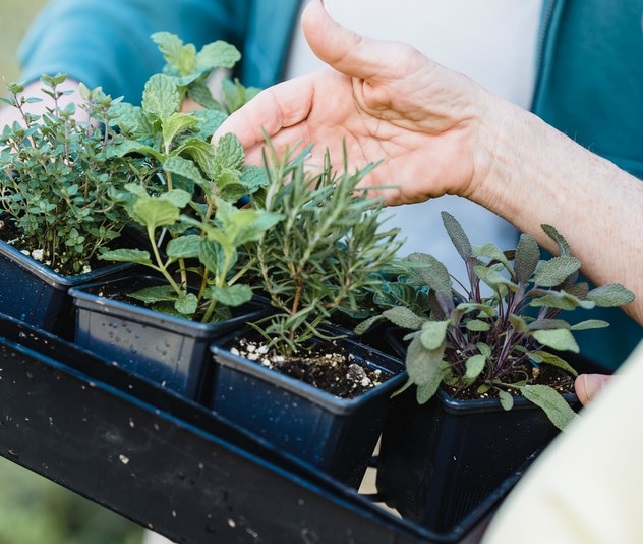
Basil, mint, rosemary and chives sell fresh. Lemon balm sells for tea, and chia for its seed.

Basil
Sold as fresh tips to exporters, hotels and supermarkets. Bruises easily, so it needs shade and a cool chain.

Mint
Sold in bunches for tea, juice and cooking. Spreads by runners, so plant it once and contain it.

Rosemary
Sold as sprigs for roasting meat. Drought tolerant and productive for years.

Chives
Sold as cut leaves in export packs. One of the two herbs exporters ask for most.

Lemon balm (melissa)
Sold dried for herbal tea, and for oil. A niche crop: find the buyer first.

Chia
Grown for seed, not leaf. Sold dry to health shops, millers and bakers.
What a Kilo of Herbs Sells For in 2026
About KSh 150 to 650 a kilo locally, by herb and buyer. Exporters’ agents paid basil growers KSh 300 to 450.
One Machakos grower sold basil through agents at KSh 300 to 450 a kilo (The Standard).
A quarter acre of basil gives 200 to 300 kg a month (Farmers Trend). That is worth KSh 50,000 to 80,000 at the farm gate.
That works out at about KSh 250 a kilo. Our model uses it.
Air freight is squeezing what exporters can pay growers. Ask for the price in writing.
How much is basil per kg in Kenya?
About KSh 250 to 600 a kilo on published local guide prices. Growers selling through export agents reported KSh 300 to 450.
Herbs Farming Profit: A Quarter Acre of Basil, Costed
About KSh 20,000 a month at 250 kg and KSh 250 a kilo. The plot breaks even at 170 kg a month.
Quarter acre of basil, one month (KSh, our model)
| Line | Amount | Basis |
|---|---|---|
| One full-time worker | 12,000 | Our estimate. |
| Casual labour for harvest and grading | 6,000 | Our estimate. |
| Transport to the packhouse | 6,000 | Two to three trips a week. |
| Water and pump fuel | 4,000 | Drip irrigation. |
| Manure and fertiliser | 3,000 | Our estimate. |
| Crop protection | 3,000 | Approved products only. |
| Certification and audit share | 3,000 | Group scheme. Our estimate. |
| Seed and replanting share | 2,000 | Basil is replanted about twice a year. |
| Crates and packaging | 2,000 | Our estimate. |
| Land lease | 1,500 | Quarter acre. |
| Total for the month | 42,500 | Our example. Yours will differ. |
One quarter acre at three harvests (KSh a month)
| Graded basil sold | Gross sales at KSh 250 | Left for the month |
|---|---|---|
| 150 kg | 37,500 | -5,000 |
| 250 kg | 62,500 | 20,000 |
| 350 kg | 87,500 | 45,000 |
Left for the month is before your own pay, tax and loan repayments.
The same 250 kg at three prices
| Price a kilo | Gross sales | Left for the month |
|---|---|---|
| KSh 150 | 37,500 | -5,000 |
| KSh 250 | 62,500 | 20,000 |
| KSh 400 | 100,000 | 57,500 |
What is the profit per acre?
Four such plots would leave about KSh 80,000 a month an acre. Few growers start there.
An acre needs a packhouse slot for a tonne a month. Scale with the buyer, not ahead of them.
Rejected kilos earn nothing. Gross sales are not profit.
What type of farming makes the most money?
High-value horticulture earns the most for each square metre: herbs, greenhouse vegetables and export crops.
It also carries the highest cost and risk. The best-paying farm is the one with a signed buyer.
Herbs pay by the kilo that passes grading. Grow for one buyer’s standard, not for the market in general.
Herbs Contract Farming in Kenya: How It Works
An exporter agrees a herb, a grade, a weekly volume and a price. You grow to their protocol and deliver to their packhouse.
- Step 1Find the exporter.Ask which herb and volume they are short of.
- Step 2Join or form a group.Exporters prefer to audit and collect from groups.
- Step 3Get certified.GlobalG.A.P. is the usual entry ticket for Europe.
- Step 4Plant to a schedule.Stagger beds so you cut every week.
- Step 5Deliver cold, the same day.Cut in the morning and keep crates shaded.
Herb exporters must register with the Horticultural Crops Directorate, and KEPHIS issues the plant health certificate (ExportReady Africa).
Before you sign, check five terms: price, grade, rejection rules, payment days and who pays transport.
Keep spray records for every bed. Residue failures end contracts.
Who Buys Herbs in Kenya, and Where to Sell
The major buyers are exporters. Supermarkets, hotels, restaurants, processors and open-air markets follow.
- 1Exporters.The largest volumes. They need certification and steady weekly supply.
- 2Supermarkets and greengrocers.Small packs and potted herbs. Ask about listing terms and returns.
- 3Hotels, restaurants and caterers.Mixed weekly orders. Deliver yourself and invoice monthly.
- 4Processors.Buyers of dried herbs for teas, spice blends and oils.
- 5Open-air markets.Coriander and mint move daily, at the lowest prices.
Exporters handling herbs include Aromatic Fresh and Mula Export, named in one 2026 exporter list.
The Horticultural Crops Directorate licenses exporters. Ask it for the current register.
Start with one buyer inside two hours’ drive. Fresh herbs lose value by the hour.
What a Quarter-Acre Herb Farm Costs to Start
About KSh 225,000, including two months of running costs. A kitchen-scale trial costs far less.
Start-up budget, quarter acre (KSh)
| Item | Budget | Basis |
|---|---|---|
| Two months of running costs | 85,000 | The monthly budget above, twice. |
| Drip kit for a quarter acre | 35,000 | Our estimate. |
| Water tank and stand | 25,000 | Our estimate. |
| Cool store: charcoal cooler or cold box | 20,000 | Our estimate. |
| Land preparation and manure | 15,000 | Our estimate. |
| Training and first certification | 15,000 | Group scheme. Our estimate. |
| Seedlings and seed | 12,000 | Basil seedlings listed at KSh 15 each. |
| Crates, shears and a scale | 10,000 | Our estimate. |
| Soil and water tests | 8,000 | Our estimate. |
| Total | 225,000 | Our example. Yours will differ. |
Seedling price from Farmers Trend.
If you borrow, read how to get farm loans in Kenya first.
Basil, Mint and Thyme Farming in Kenya, in Brief
Basil is the volume crop, mint the easy perennial and thyme the high-price, slow one.
Basil farming
First cut at about 45 daysWarm, sheltered sites or tunnels.
Cut every one to two weeks; replant about twice a year.
Mint farming
First cut at 6 to 8 weeksMoist, rich soil and some shade.
Plant runners once and harvest for years.
Thyme farming suits cool, well-drained sites. It dislikes wet soil.
Thyme yields less a bed than basil, so it needs the higher price.
Direct-sow coriander and dill. Their taproots dislike transplanting.
Keep moisture-loving herbs and Mediterranean herbs in separate beds, with separate watering.
Six Tea and Medicinal Herbs Worth a Trial Bed
Ashwagandha, chamomile, lemongrass, stinging nettle, fenugreek and gotu kola. Each has a small market, so trial a bed first.
Root crop
Sold as dried root and powder. A niche crop with few local buyers.
Tea
Sold as dried flowers, which need careful drying.
Tea and oil
Grown from splits, and sold fresh, dried or distilled.
Tea and vegetable
Sold dried or as powder. Common in the highlands.
Seed and leaf
Sold as seed and powder to spice traders.
Niche
Low volume. Confirm a buyer before planting.
Oregano, bay leaves, dill, fennel seed, spearmint and dandelion sell into the same tea and spice trade.
Dry these herbs fully and pack them in breathable bags. Damp herbs rot.
Sell them as food or tea. Health claims on a label bring medicines regulation.
Dried Herbs, Teas and Potted Plants: More From Each Bed
Dry and pack, blend into teas, distil oil, or sell living herbs in pots.
- 1Dried herbs.Longer shelf life, and a use for stems that miss the fresh grade.
- 2Herbal tea blends.Mint, lemongrass, lemon balm and chamomile, packed in small pouches.
- 3Essential oils.Rosemary, mint and lemongrass. Distilling needs volume and equipment.
- 4Potted herbs.Sold to homes, landscapers and garden centres.
Herbs for hedges, borders and pots are covered in the best herbs for landscaping in Kenya.
Potted herbs also sell to home gardeners taking up foodscaping in Kenya.
More processing ideas are in value addition business ideas.
Herbs Farming Training in Kenya: Where to Learn
From exporters’ agronomists, county extension officers, the Horticultural Crops Directorate and certified herb farms.
Exporters train contracted growers on their own protocols. That training is the most useful.
Ask your county agriculture office about horticulture field days and group registration.
Before paying for any course, ask to see the trainer’s farm and buyer.
Agcenture designs training and business plans for grower groups and agribusinesses.
What Goes Wrong in Herbs Farming
Rejections at grading, a buyer who stops collecting, a broken cool chain and residue failures.
Do this
- 1Start with two or three herbs
- 2Sign terms before planting
- 3Harvest early and keep crates shaded
- 4Record every spray
Avoid this
- 1Planting an acre for an unnamed buyer
- 2Mixing wet-loving and dry-loving herbs
- 3Unapproved pesticides
- 4Relying on one season’s export price
Herbs pay by the kilo that passes grading. Grow for one buyer’s standard, not for the market in general.
How to Start a Herb Company in Kenya
Pick two or three herbs with a named buyer. Register the business, test soil and water, and plant in weekly blocks.
- 1Choose the buyer and the herbs.Two or three herbs the buyer is short of.
- 2Register the business.A business name or company, a KRA PIN and a county permit.
- 3Add the licences your product needs.An export licence for exporting. A standards mark for packed teas and dried herbs.
- 4Set up water and a cool store.Drip irrigation, shade and clean crates.
- 5Plant in weekly blocks.A bed sown every week gives a cut every week.
Three herbs that grow well together are basil, parsley and chives. They share rich soil and regular water.
Test first. See soil testing in Kenya.
Then write the plan with our farm business plan guide.
Planning a herb enterprise?
Agcenture prepares market checks, gross margin analyses, business plans and grower training. Tell us your county and your buyer.
Written by Agcenture
Agcenture helps Kenyan farmers and food businesses plan, finance and grow. Our guides use public sources and clearly labelled assumptions.
Questions readers ask
Which herb is most profitable?
Basil, for most Kenyan growers. It is cut every one to two weeks and has the largest export demand.
What are the most profitable herbs to grow in Kenya?
Basil, chives, coriander, mint and rosemary, followed by thyme, parsley, oregano, sage and dill.
Which herb is most in demand?
Basil and chives for export. Coriander and mint in local markets.
What are the 10 types of herbs?
Basil, chives, coriander, mint, rosemary, thyme, parsley, oregano, sage and dill.
What are the best herbs to grow and sell?
Basil, chives, coriander, mint and rosemary.
Who are the major buyers of herbs in Kenya?
Exporters first. Then supermarkets, hotels, restaurants, processors and open-air markets.
How much is basil per kg in Kenya?
About KSh 250 to 600 on local guide prices, and KSh 300 to 450 through export agents.
How do you start a herb company?
Secure a buyer, register the business, get the licences your product needs, then plant in weekly blocks.
Is herbs farming in Kenya profitable?
It can be. Our quarter-acre basil model leaves about KSh 20,000 a month, at 250 kg and KSh 250.

THIS IS GREAT IN AGRIBUSSINESS IN KENYA